

In heating and plumbing applications, the data plate operates in one of the harshest environments imaginable for printed information, and it is often the component given the least attention at the design stage. On a boiler, a heat pump or a heat exchanger that has been installed for years, the manufacturer, serial number, maximum pressure, output and efficiency class must remain legible precisely when they are needed: during an inspection, a service or a compliance check. If, at that point, the adhesive label has peeled away or the ink has faded, the information is lost, and with it the ability to order the correct spare part or to document the appliance.
The reason lies in the environment. In plant rooms the air is warm and saturated with moisture, and the metal surface continually rises above and falls below the dew point: condensation forms, lingers, evaporates and returns, cycle after cycle. It is a constant stress, acting throughout the life of the appliance precisely on the carriers — the adhesive of a label, the film of an ink — that are meant to hold the information in place.
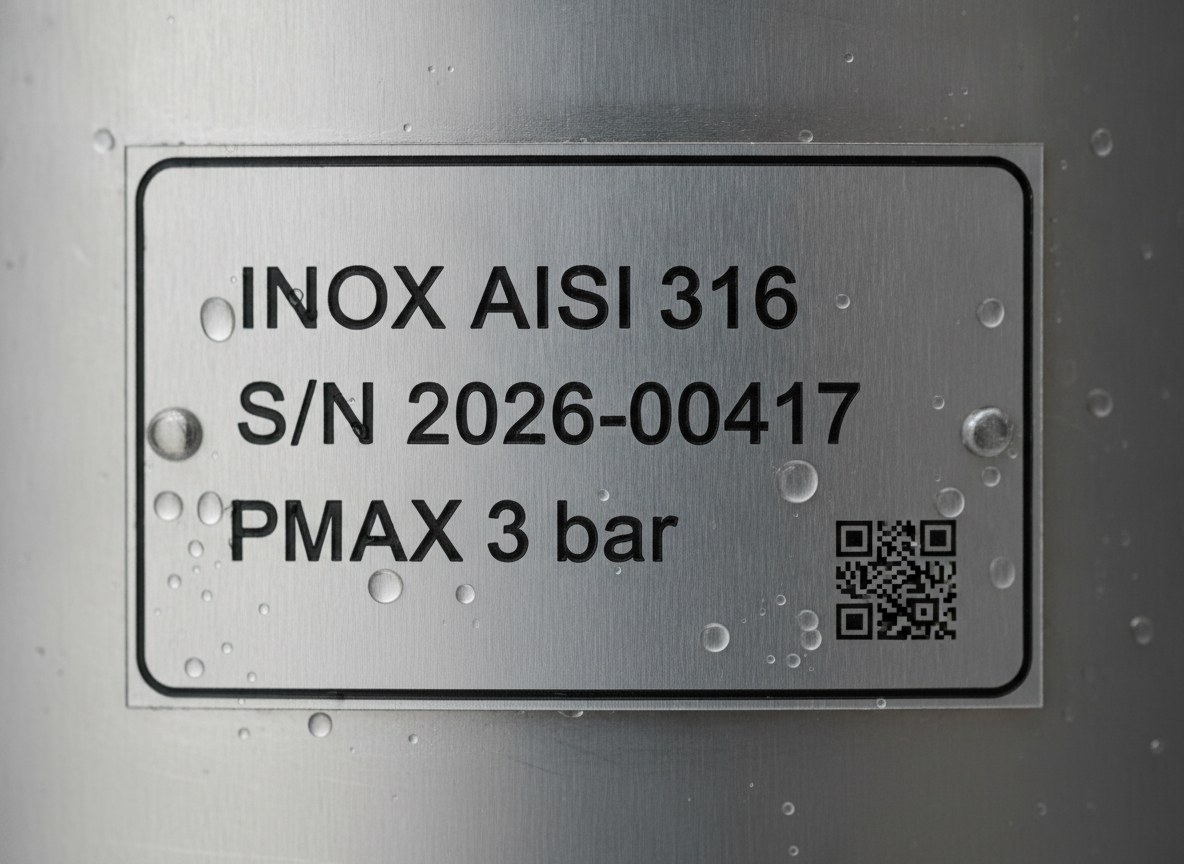
Direct laser marking tackles the problem at its root, because it adds nothing to the surface: it modifies the metal itself. It is not, however, the right answer for every surface and every layout, and it is worth seeing where it genuinely wins and where a label or screen printing remains preferable.
Why adhesive and ink fail where condensation is present
An adhesive label depends on its layer of glue, and in a plant room moisture almost always finds a path beneath the film. When the temperature drops below the dew point the water condenses right at the interface, the expansion cycles between metal and adhesive work at the edge until they lift it, and from there the peeling advances, bringing with it the oxide that fouls the reading. Ink, whether inkjet or screen-printed, is by definition a thin applied layer: moisture, slightly acidic condensation, cleaning agents and abrasion wear it away. Screen printing with cured inks holds up better than a solvent-based inkjet, but it remains a film on top of the surface, not part of it. This is where direct laser marking compared with inkjet printing starts from a structural advantage: there is no layer to lose.
The mark is the material, not an applied layer
The laser deposits nothing; it modifies the surface layer of the metal. Depending on the parameters, the mark can be a dark oxide grown through annealing — a colouring of the oxide lattice without material removal — or a micro-engraving that removes a few microns of material. In either case there is neither glue nor pigment, and condensation, thermal shocks and cleaning agents find no applied layer to attack. An annealing mark maintains a stable contrast from any angle and under any light, an essential condition both for human reading of the plate data and for automatic reading of codes. The behaviour, however, changes markedly from one metal to another, and that is where it is decided whether direct marking is genuinely the correct choice.
Galvanised and painted sheet: marking without opening the door to corrosion
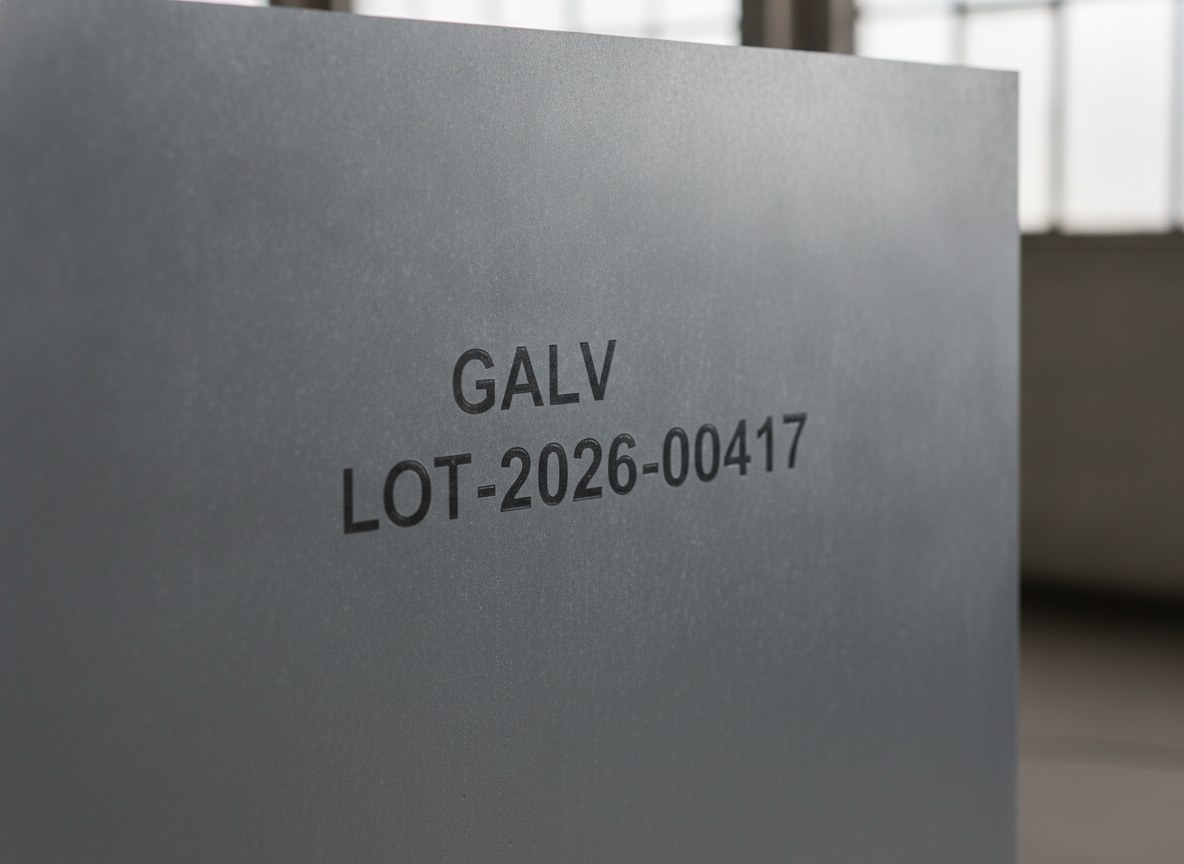
On galvanised sheet the temptation is to mark for contrast by removing the zinc until the steel is exposed. In a room with condensation this is exactly what should not be done: it creates a point with no protection, and the rust starts right at the mark. The correct approach is to modulate the heat input — a controlled pulse, typically with a MOPA source — to darken the layer without removing it, keeping the corrosion protection continuous.
The same applies to painted or powder-coated sheet: ablating the paint down to the metal gives immediate contrast but exposes the substrate to moisture at a localised point, whereas it is better to act on the coating without exposing the underlying metal. It is the fine control of the parameters, more than the power itself, that distinguishes a durable mark from one that becomes a trigger for corrosion.
Stainless steel and plate heat exchangers: black annealing and stable contrast
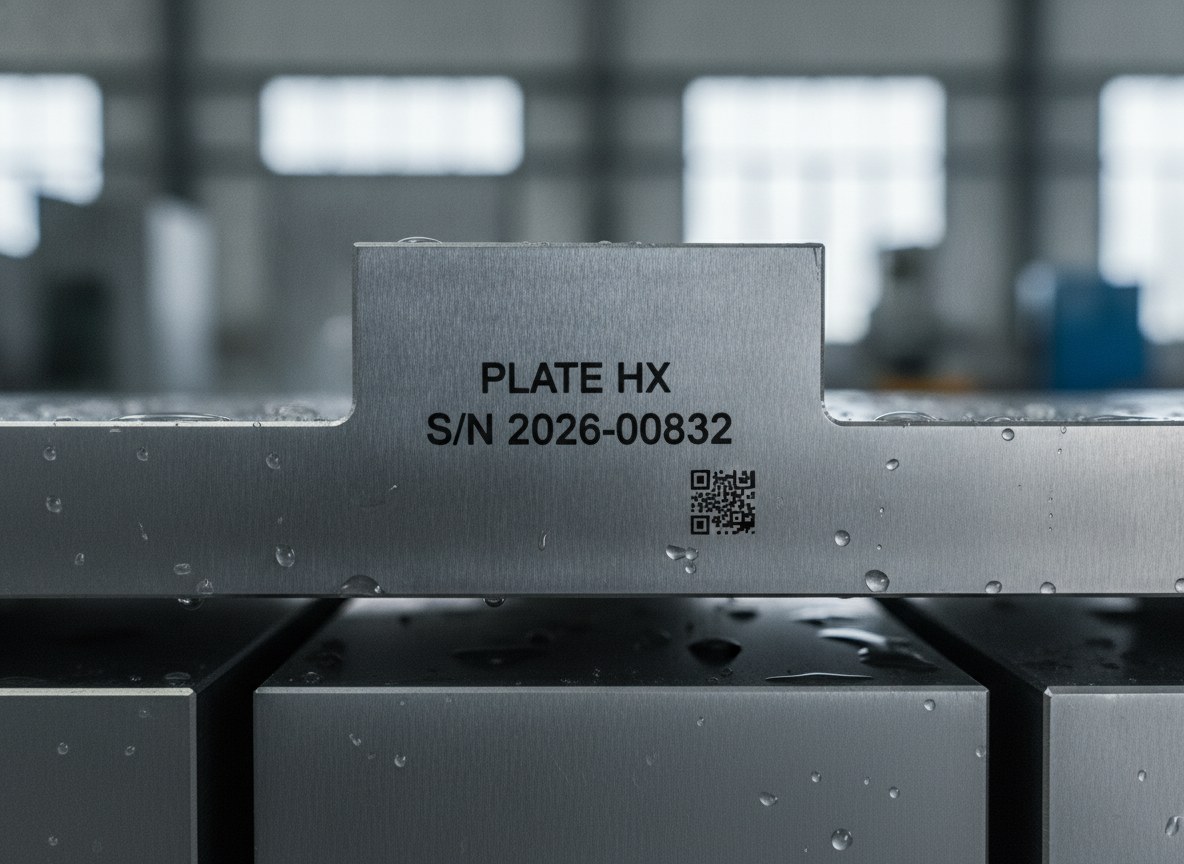
Stainless steel is the ideal material for direct laser marking in a damp environment. Annealing produces a deep black mark, integrated into the surface, that survives condensation and thermal cycles without degrading. The care lies in dosing the energy: an overly aggressive annealing can locally alter the passive layer, so the parameter must be calibrated to achieve the required contrast while preserving corrosion resistance, as is generally considered with the surface treatment of steel with the laser. Plate heat exchangers are the emblematic case: stacks of thin stainless steel plates where the serial number and data must be engraved permanently without adding thickness or carriers. The mark remains part of the plate and stays with it throughout its life, including washing phases and the temperature cycles of operation.
Copper and reflective alloys: the source makes the difference
Copper, widespread in piping, manifolds and heat exchangers, is the most awkward metal. At the fibre’s 1064 nm wavelength it is highly reflective and conducts the heat away too quickly, and the mark comes out inconsistent. The correct route is to change the wavelength: the green source at 532 nm is absorbed far better by copper and delivers a clean, repeatable mark even on polished surfaces. On brass and bronze, typical of valves and fittings, the fibre becomes suitable again and gives crisp, stable marks. In heating and plumbing there is no single laser that is good for everything, but rather the right source for each metal: defining it in advance, on the product’s actual materials, is what prevents weak marks that later fail in the field.
The legibility of the mandatory data, measured over time
The requirement is not “to mark”, it is to remain legible years later, when the appliance has already worked for a long time in a damp environment. Alongside the alphanumeric data, more and more plates carry a DataMatrix or a QR code that links the serial number to the technical documentation and the energy data: an unreadable code is lost data. The stable contrast of laser marking is what makes the code reliable over time and enables in-line grading — the applicable control standard during production — while the formal verification of code quality remains an operation for controlled laboratory conditions. A mark that neither peels nor fades is the precondition for both checks to remain meaningful.
When a label or screen printing remains the right choice
Direct marking does not cover every case. There are surfaces that one does not wish to, or cannot, alter — aesthetic finishes, certain technical coatings, plastic housings — and points that the laser head can no longer reach after assembly. In these situations the robust solution is a metal nameplate laser-marked and then fixed to the part: the permanence of the mark engraved in the metal is retained, but the marking is decoupled from the product’s surface.
Then there are the layout constraints. When the mandatory data are numerous, or when regulated coloured logos and safety pictograms are needed, the natural field is screen printing or a pre-printed label, because marking on metal works on the contrast of the surface and does not reproduce full-colour graphics. In short: where the data must last as long as the appliance, in environments with condensation and thermal cycles, direct laser marking is the most reliable; where the surface cannot be marked or the layout calls for colour and graphics, laser-marked labels and screen printing remain complementary, not competing.

Public Relations Manager | LASIT
Public Relations Manager at LASIT since 2019, Claudia Neri is responsible for managing the Marketing and Communications department. She handles the company’s communication strategy, coordinating public relations, brand promotion and institutional communication activities for the Italian and international market.


