

Anyone engraving wedding bands, rings and silverware works with materials that allow no second chances. A polished precious metal is, at the same time, the most visible surface of the piece and the one with the highest intrinsic value: an engraving error cannot be hidden and cannot be recovered — it is scrapped. And on a metal already turned into a piece of jewellery, with hours of work and polishing behind it, that scrap weighs in an entirely different way compared with a mechanical component.
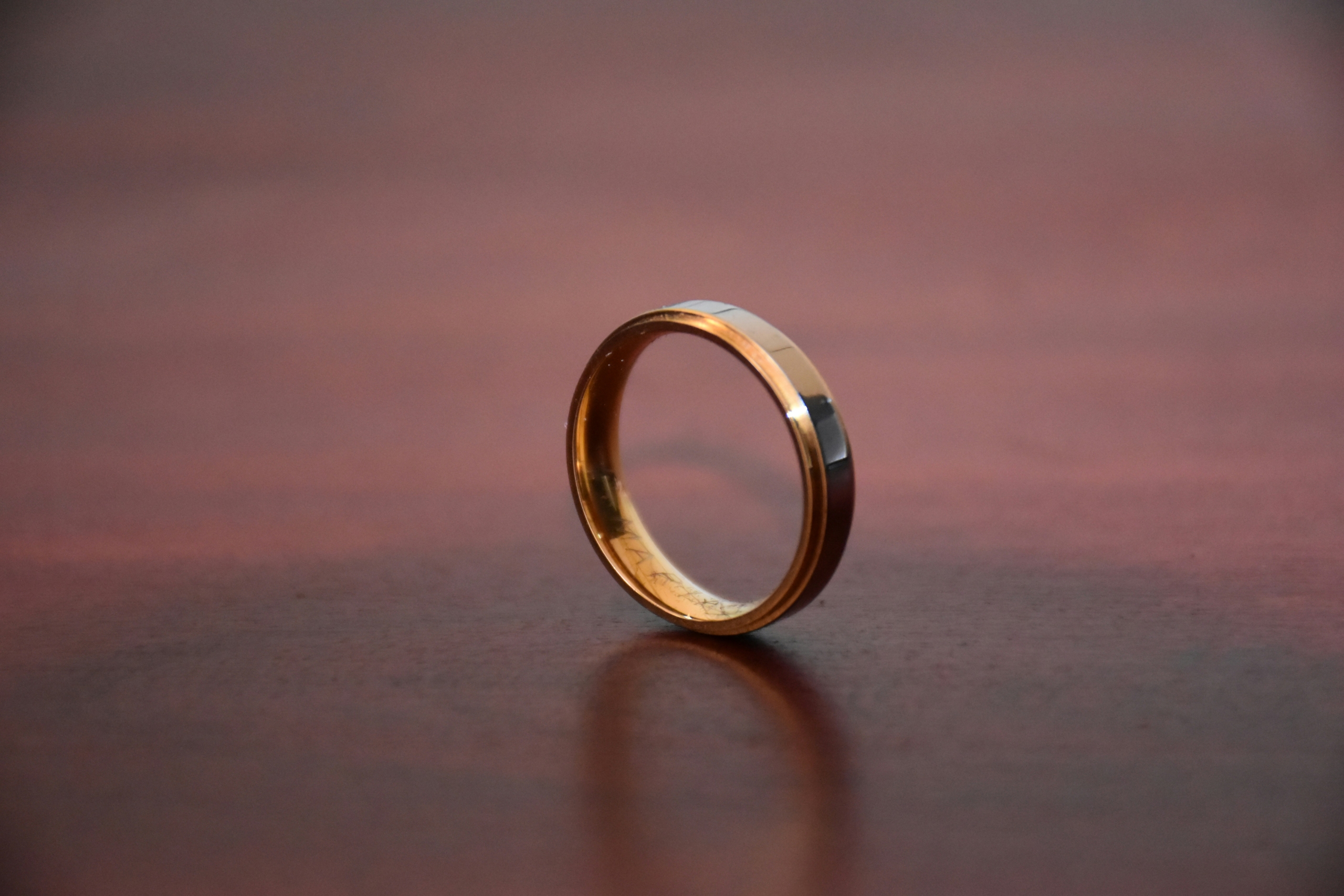
To these stakes a precise physical problem is added. Gold, silver and platinum are among the most reflective materials in existence at the wavelength of industrial fibre lasers, 1064 nm. A significant part of the beam’s energy is sent back by the polished surface instead of being absorbed, and silver in particular — the most reflective of the three — is the limiting case. Managing this reflectivity is the precondition for achieving a fine, clean and repeatable engraving without affecting the surrounding polish. The term metal engraving is the correct one here: material is removed in a controlled way, a colour is not printed.
The difference between just any marking and reliable bench work is played out precisely here: in the control of the process parameters and in the mechanics that keep the beam where it belongs, engraving after engraving.
Why gold, silver and platinum put the beam to the test
The reflectivity of a precious metal is no minor detail: it determines how much of the energy the material actually absorbs and how much is repelled. On a mirror-finished surface absorption is low, and this means that the useful parameter window — peak power, frequency, scanning speed — is narrower and must be calibrated to the individual metal and its finish. This is not work to be improvised by eye: it is a process definition that starts from trials on real samples of the same fineness and the same polish as the finished piece.
The three alloys do not behave in the same way. Gold offers good contrast and a predictable result once its window has been found; platinum, less reflective than the other two, tends to give a clean engraving that is easier to control; silver remains the most demanding, because its extreme reflectivity leaves little margin and calls for the finest management.
| Metal | Reflectivity at 1064 nm | Behaviour in engraving |
|---|---|---|
| Gold | High | Predictable contrast once the parameter window is found |
| Silver | Very high, the most critical | Narrow margin: requires the finest management |
| Platinum | More contained than the other two | Clean engraving that is easier to control |
The 1064 nm fibre beam remains the benchmark choice for these materials because it works all metals and concentrates the energy on a diameter of the order of hundredths of a millimetre, a necessary condition for a fine line on a small piece. Anyone wanting to understand the basic mechanism can start from how laser engraving works; on precious metals, the step up in quality lies in tuning that mechanism to the reflectivity of the specific alloy.
Internal engraving of wedding bands with the rotary axis
The most requested engraving in jewellery is the internal engraving of wedding bands: dates, names, symbols and references running along the inner circumference of the ring. It is also the most critical from a geometric point of view, because the surface to be engraved is curved and hidden, and the beam must remain perpendicular and in focus at every point around the ring.
The solution is the rotary axis: the band is clamped on a mandrel and set to rotate in synchronisation with the scanning of the beam, so that the text develops uniformly along the entire inner circumference without distortion. The laser always works on the point where the angle of incidence is correct, while the ring rotates beneath it. The result is a consistent line from the first to the last character, regardless of the diameter of the band.
This approach also has concrete value for repeatability. A hand-engraved band depends on the craftsman’s gesture; a band engraved with a rotary axis and defined parameters delivers exactly the same result on every piece of an equal size, whether it is a pair or a small batch. The legibility of a date or a short name remains constant even on the smallest sizes, where the internal space is limited and any misalignment would show.
Maker’s mark, fineness and identification hallmarking
Alongside personalisation, precious metal carries an identification function. The responsibility mark and the fineness hallmark — the indication of the alloy’s purity — are elements that accompany the piece and declare its nature. The laser performs these markings permanently and repeatably, with a controlled line that does not deform the surrounding metal as a struck punch would.
On this ground, laser engraving meets the theme of traceability and authenticity. A unique serial number, a micro-symbol or a code can tie the individual object to its documentation, an aspect that on fine silverware and valuable pieces becomes a means of protection. It is the same principle by which laser markers against counterfeiting work on elements that are difficult to reproduce and impossible to remove without leaving a trace on the surface.
Fine marking on already-polished surfaces
The aesthetic challenge is to engrave on a mirror-finished surface without ruining it. On a polished piece, every mark out of place is visible to the naked eye, and the contrast of the engraving must arise from the contrast between the worked area — more matt or satin-finished — and the surrounding mirror finish left intact. This is why control of the heat input is central: the aim is precise surface removal, not a deep groove that creates burrs or halos on the surrounding polish.
A finely focused beam allows minute details — monograms, decorative fillets, micro-symbols — while keeping the edges crisp. The quality of the result, however, depends as much on the laser as on the starting finish: defining the process on a sample that reproduces the same polish as the actual piece is the way to avoid surprises in production.
One-off personalisation at the bench
Much of the work in jewellery is not batch production but on a single piece: the engraving requested by the customer on the spot, the date of an anniversary, a name. In this scenario the value is not cycle speed but flexibility and the assurance of getting the result right first time, because there is no second piece to fall back on.
A well-set-up bench flow — clamping the piece, setting the size, engraving with parameters already validated for that alloy, visual check — makes the operation repeatable even when every piece is different. Preparing the engraving file is a graphic operation on the computer, not a configuration to be redone from scratch every time: the layout is recalled, the text is adapted and the job is run.
Who it is designed for (and who it is not)
Laser engraving performs at its best where precision, repeatability and permanence are needed: the inside of wedding bands with the rotary axis, maker’s marks and fineness hallmarks, fine monograms, serial numbers for traceability and protection of authenticity on jewellery and silverware. On gold and platinum the process is solid and predictable once the parameters have been defined.
There are, however, cases to be handled realistically. Mirror-polished silver is the most awkward: its extreme reflectivity narrows the working window and, on a full mirror finish, the contrast of the engraving may require a deliberate choice of result — often a controlled satin effect rather than a deep line. And where the client is looking for the depth and mark of the traditional graver, hand craftsmanship engraving remains an aesthetic language in its own right: the laser is complementary, not a substitute for that gesture. In all these cases the correct path is the same: trials on the real materials and finish, before taking the process onto the valuable piece.

Applications Manager | LASIT
Applications Manager at LASIT for over 20 years, Mario Palmieri oversees the management and development of the company’s laser laboratory. He is responsible for conducting sample tests for customers, supporting the automotive, medical, aerospace and electronics sectors in identifying the most suitable laser marking solution for their needs.


