

Anyone who manufactures implantable titanium screws, abutments or plates knows perfectly well why that surface must be treated with care: the problem is that marking is the last operation to touch it, and it is the point where all that care risks being undone. Any technique that removes material, deposits residues or alters the oxide film (TiO₂) in an uncontrolled way calls into question the very characteristic for which the part exists. On an implantable component, in short, marking is not a cosmetic step.
At the same time, the regulatory framework leaves no room for compromise. An implantable device must carry a legible, permanent UDI identifier throughout its life cycle, and the code must survive washing, passivation and repeated sterilisation cycles without becoming illegible and without creating micro-cavities that turn into initiation points for contamination or corrosion.
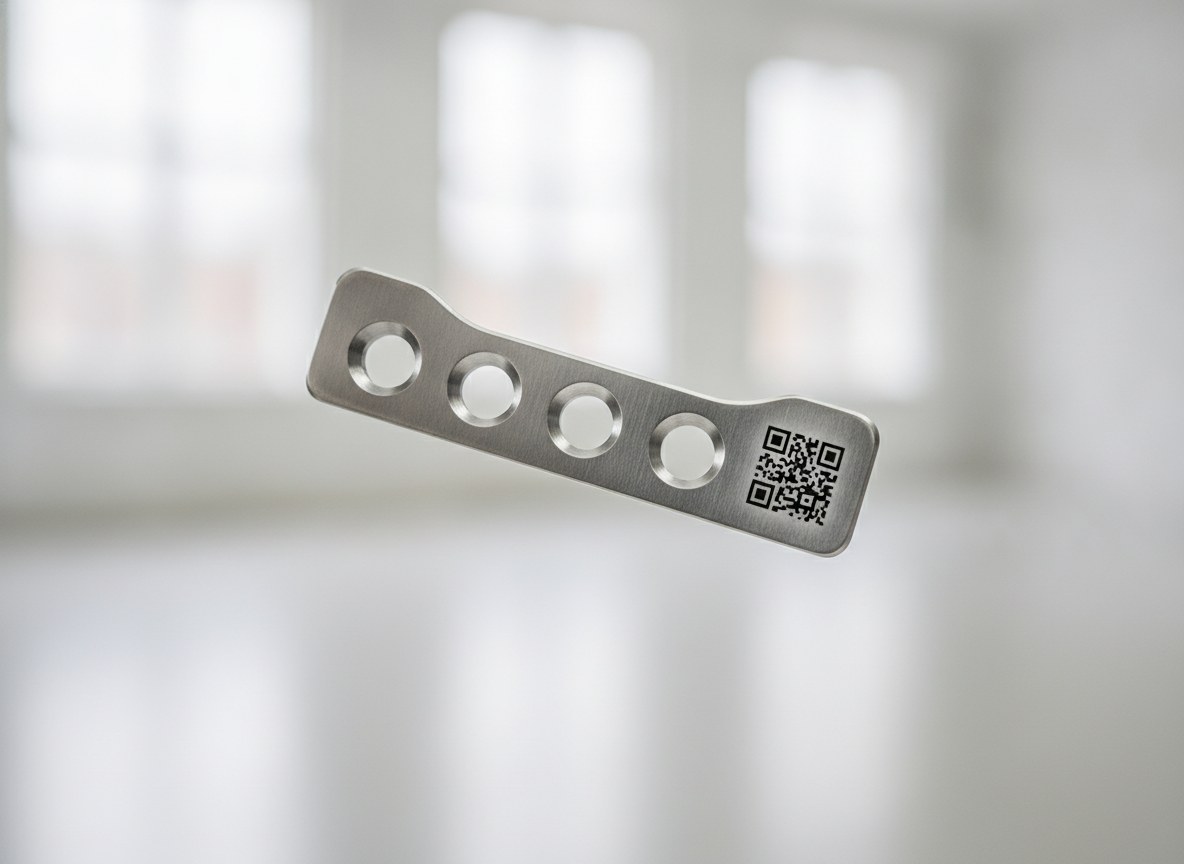
Laser marking by controlled oxidation tackles both constraints together: it generates contrast — and colour — by modifying the oxide layer instead of removing it, without adding foreign material and without compromising downstream treatments.
The right criterion for choosing marking on implantable parts
On an implant, the surface is inspected and documented with the same care reserved for dimensional tolerances. From this follows a simple criterion for judging a marking technique: what it does to the oxide layer. Ink marking deposits foreign material, which then has to be removed or which remains as a potential contaminant. Mechanical engraving or micro-punching remove metal and create grooves with edges and burrs — that is, geometries that are difficult to clean and to passivate. These are the same reasons why, for the traceability and MDR compliance of dental implants, the choice of marking technology is to all intents and purposes a process decision, not a finishing one.
Interference colour: how it forms on titanium
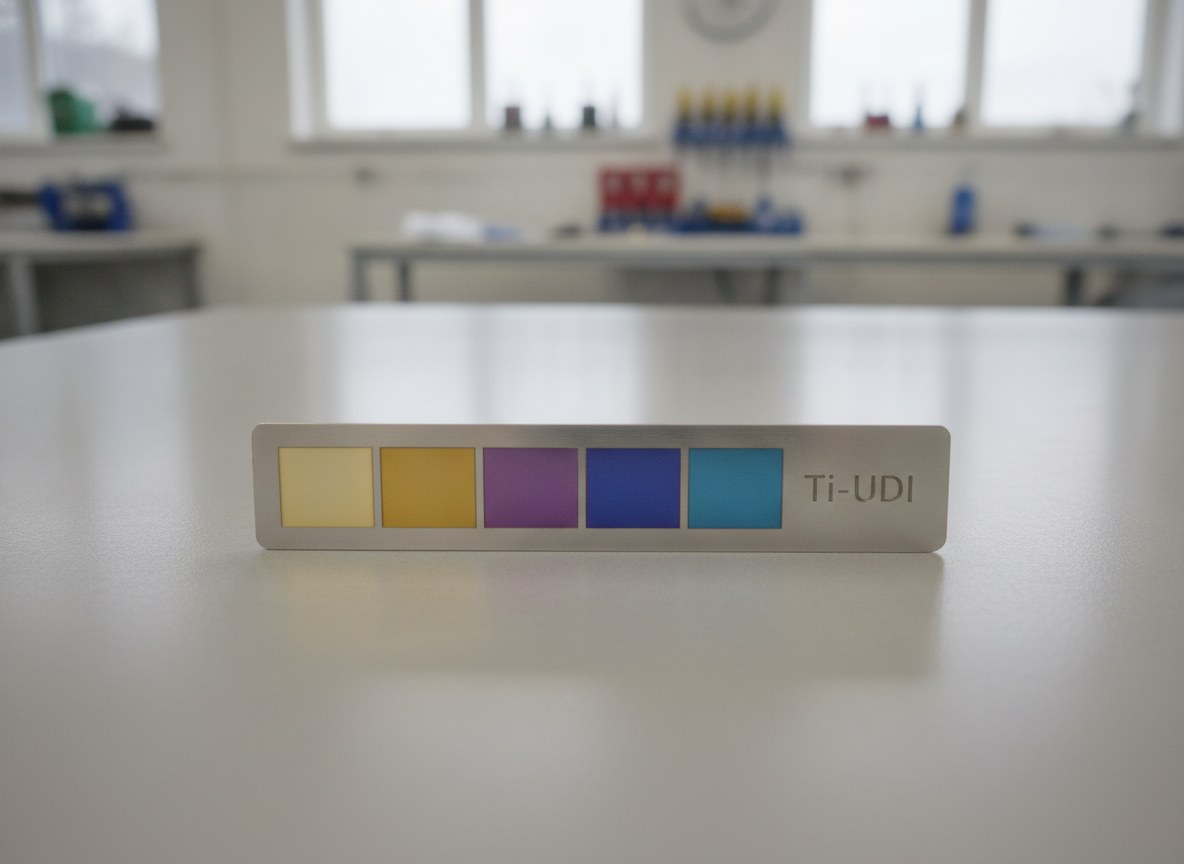
When a 1064 nm beam runs across the titanium surface without removing it, it heats the metal for the very brief time of the pass and accelerates its local oxidation. In this way a transparent oxide film of controlled thickness grows. The light striking this film is reflected partly at its outer surface and partly at the oxide-metal interface: the two waves recombine and, depending on the thickness travelled, some wavelengths reinforce one another while others cancel out. This is the phenomenon of thin-film interference, the same one that colours a film of oil on water.
The technical point to hold firm is that here the colour is not a pigment and not a paint: it is a structural property of the oxide. By varying the energy density you vary the film thickness, and with the thickness the hue changes — from straw yellows to brasses, to purples, to blues. These are the real hues that titanium produces as it oxidises, not arbitrary “print-like” colours. This distinction matters at the specification stage: you can define a palette of repeatable tints tied to process parameters, not just any free colour.
Oxidation without removal: no residue, no particulate
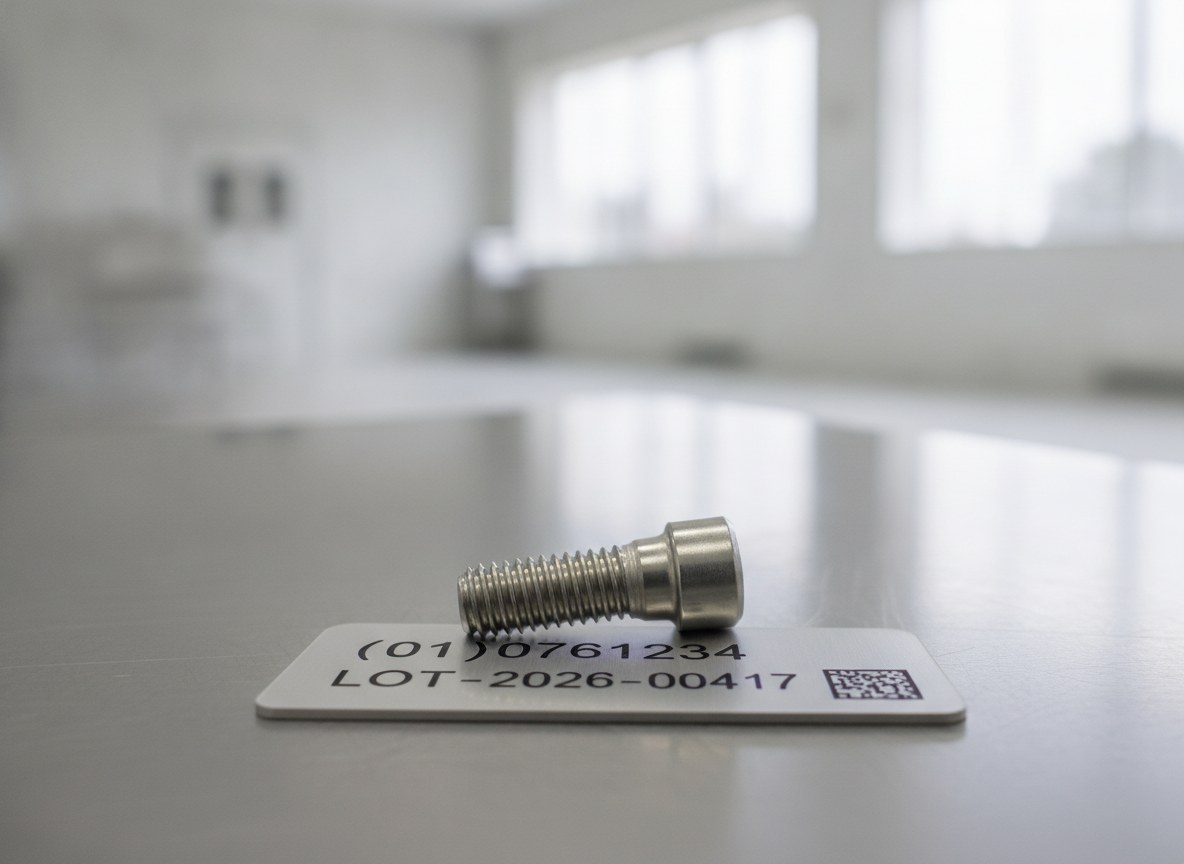
The decisive difference from engraving is that controlled oxidation does not cut in. The surface stays continuous: no grooves, burrs or dust are generated, and no filler material is introduced. For an implantable component this means not creating geometries that trap contaminants and not leaving particulate on the surface that surface texturing of implantable components and the subsequent washes would then have to deal with.
It must be said with technical precision: oxidation is by its nature a controlled thermal process — an oxide is grown by heating the metal locally — so it is not correct to speak of zero heat input. The value lies in governing it: energy metered to grow the required oxide without altering the substrate in depth, without melting and without re-melting of the edge. The marking stays on the surface, where it is needed, and the core of the component is left untouched.
Oxidation, ink and engraving compared
Set side by side, the three techniques differ precisely in what they do to the oxide layer. Laser oxidation grows it in a controlled way, without adding anything and without removing anything: it leaves no residues or particulate, maintains high permanence after passivation and sterilisation because the contrast is part of the surface itself, and introduces no contaminants that would disturb any downstream anodising.
Ink marking, by contrast, does not modify the oxide but deposits foreign material on top of it: a deposit that then has to be removed, that tends to degrade with washing and sterilisation cycles and that, on downstream anodising, risks interfering with the bath. Mechanical engraving, on the other hand, offers high permanence, but achieves it by removing metal: it creates grooves and burrs, geometries that are difficult to clean and to passivate, with dust and edges that trap contaminants and that alter the growth of the anodic film. It is the comparison that explains why, on implantable parts, the right technique is chosen on the basis of the effect on the oxide and not on the aesthetic result.
Colour repeatability as a process parameter
On an implant the tint is not aesthetic: it is information. A colour may encode a size, a family or a stage, and to count as a code it must be repeatable part after part and batch after batch. Since the hue depends on the oxide thickness, and the thickness depends on the energy density deposited, repeatability is a matter of parameter control: power, frequency, scanning speed, line pitch and focus must be set and kept stable.
Two mechanical and optical factors weigh in here. First, focus stability on the real geometry of the part: on curved surfaces or on screws the working distance changes, and with it the energy density, and therefore the tint. Second, the constancy of the source and of the starting surface: a homogeneous incoming surface state is the precondition for a homogeneous outgoing oxide. Colour repeatability, in short, is built upstream through the definition of the cycle; it cannot be recovered downstream.
Permanent UDI and its verification
In terms of traceability, controlled oxidation also produces the dark contrast needed for a legible DataMatrix marked directly on the part, without removal. Permanence is the central requirement for implantable parts: the code must remain legible after passivation and after repeated sterilisation cycles, conditions in which a merely deposited marking tends to degrade. A contrast obtained by oxide, and not by removal, is born from the outset as part of the surface.
On quality control, a distinction that is substantial in the medical field must be maintained: grading and code verification are two different things. Grading according to the applicable ISO/IEC standard is the quality assessment that can be carried out in line, part by part, to establish that the DataMatrix falls within the required class; verification in the strict sense requires controlled laboratory conditions. Documenting which of the two is performed, and with what instrumentation, is an integral part of managing compliance and the causes of UDI non-conformities on metal.
Compatibility with downstream anodising
Many titanium components receive downstream anodising, typically for colour coding or for surface conditioning. Since anodising also works on oxide growth, the marking stage must leave nothing on the surface that would interfere with the bath or with the homogeneous growth of the anodic film. This is precisely the advantage of laser oxidation: it deposits no material and leaves no residues, so it introduces no contaminants that would compromise the subsequent treatment. The sequence between marking and anodising must nonetheless be defined and validated together, because both act on the same layer and both must be documented.
How the process is documented for the technical file
For an implantable component, marking enters the technical file as a process, not as a detail. This means setting and recording the parameters that determine the oxide — power, frequency, speed, pitch, focus, wavelength — and tying them to the tint and grading class obtained, so that the result can be traced back to known conditions. It means validating the cycle on real samples, verifying the permanence of the code after passivation and sterilisation, and documenting that the marking does not alter the state of the oxide relevant to biocompatibility, according to the applicable criteria.
Process traceability closes the loop: versioned parameters, locked recipes, grading outcome archived by batch. It is the same logic of documentary compliance already discussed for direct UDI marking on metal, applied to the specific case of implantable titanium, where what is at stake is not only legibility but the integrity of the surface that makes the part fit for use.
Who it is designed for (and who it is not)
Controlled oxidation on titanium is the natural choice when a permanent identifier and the guarantee of not altering the surface oxide are needed at the same time: dental screws and abutments, plates, implantable components in titanium and its alloys, with a requirement for repeatable colour coding or for a high-contrast DataMatrix marked directly on the part. It is also suitable when an anodic treatment is planned downstream, precisely because it leaves no residues.
It is not, however, the right answer for every medical requirement. Where a matt, non-iridescent black marking is needed on steel instruments destined for multiple aggressive passivations, or where the requirement is maximum resistance of the contrast to repeated sterilisation cycles, the most suitable configuration is the picosecond source: ultra-short pulses that generate a deep, stable black marking with negligible thermal impact on the substrate, without iridescent tints and without the micro-cavities of engraving. It is the technology we explore in depth when discussing the picosecond for medical devices, where the priority is a dark contrast that resists washing more than an interference tint matters. And if the component is not made of titanium, the mechanism of interference colour simply does not apply: the reasoning has to be reworked on the actual material. In summary: if the part is implantable titanium and the constraint is to mark it without touching the oxide that makes it biocompatible, controlled oxidation is the technique built precisely around that constraint.

Public Relations Manager | LASIT
Public Relations Manager at LASIT since 2019, Claudia Neri is responsible for managing the Marketing and Communications department. She handles the company’s communication strategy, coordinating public relations, brand promotion and institutional communication activities for the Italian and international market.


