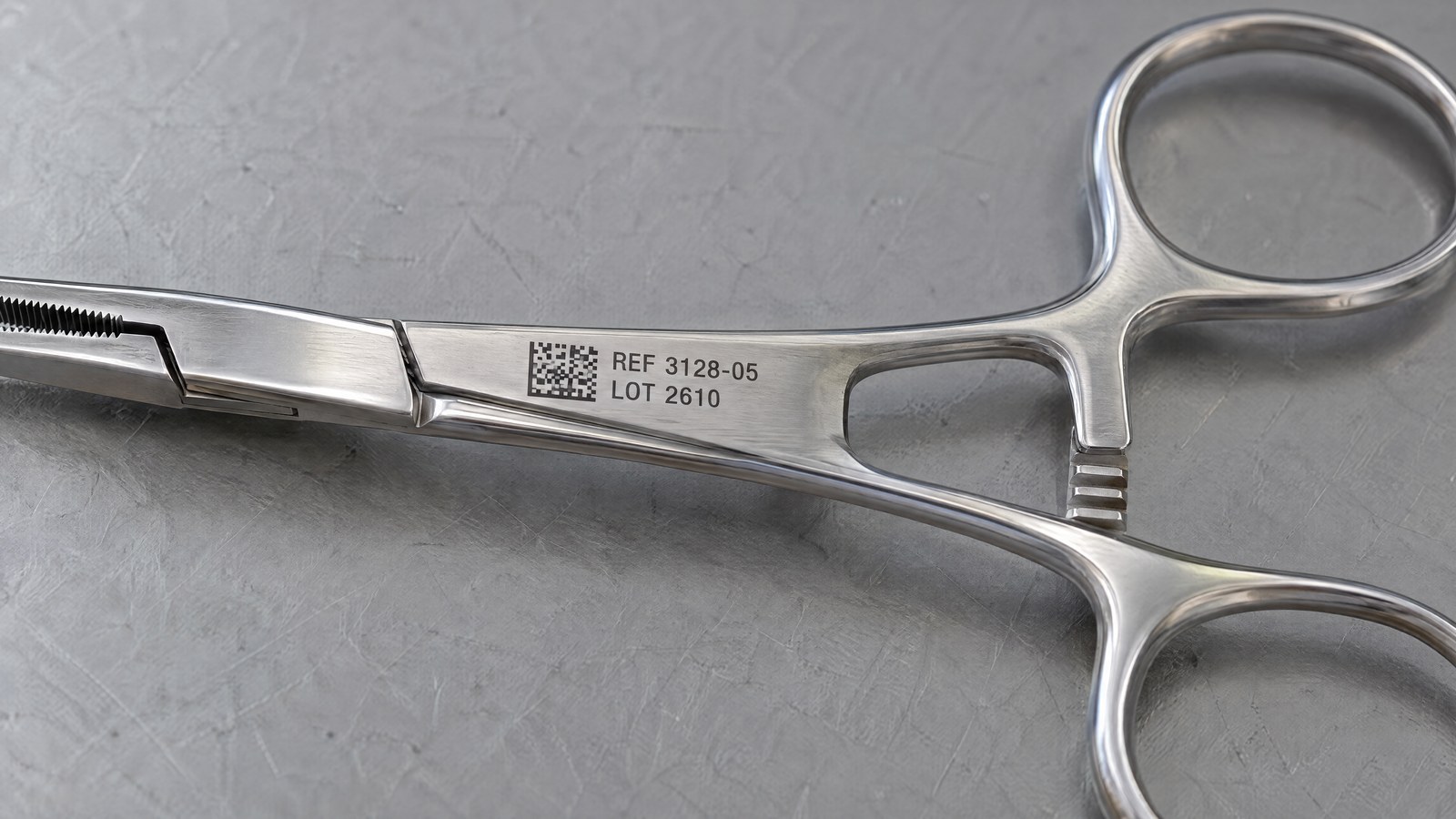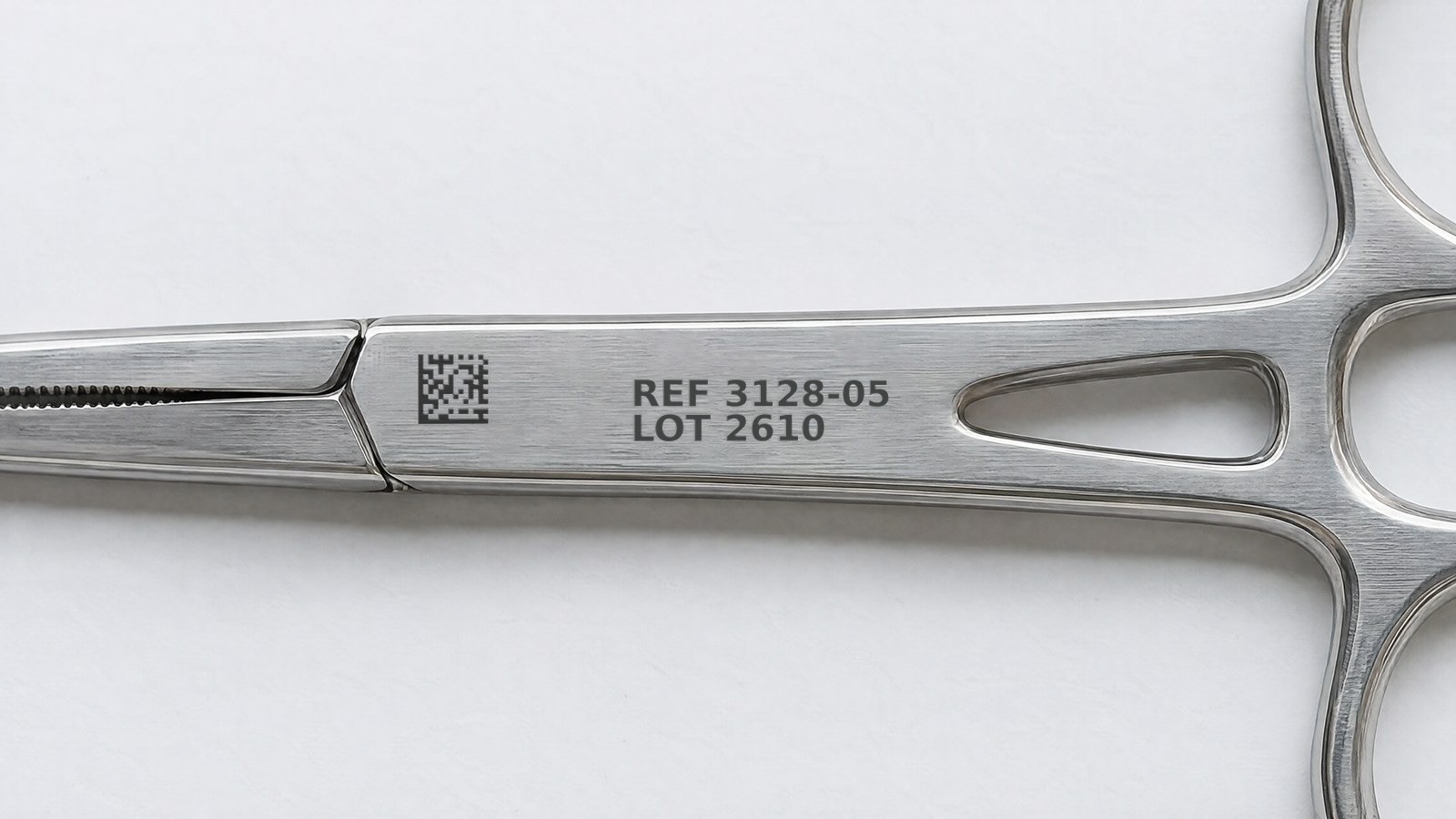
Anyone who manufactures dental burs, rotary instruments and surgical tools in stainless steel knows a constraint well that goes beyond legibility alone: black marking — DataMatrix, UDI code, batch serial — is not the final step of the cycle. After it comes passivation, the bath in citric or nitric acid that removes free iron from the surface and restores the passive chromium layer that makes stainless steel suitable for medical use. A marking that goes into that bath and comes out faded, discoloured or with degraded contrast becomes a non-conformity precisely after the treatment that should make the part usable.
The point that is often missed is that «black on stainless steel» is not a single thing. Two laser technologies produce a black that looks similar to the naked eye, but which arises from an opposite physical mechanism: the thermal black of MOPA and the structural black of the ultra-short pulse. It is the way that black forms that decides whether it survives the acid, not its initial shade.
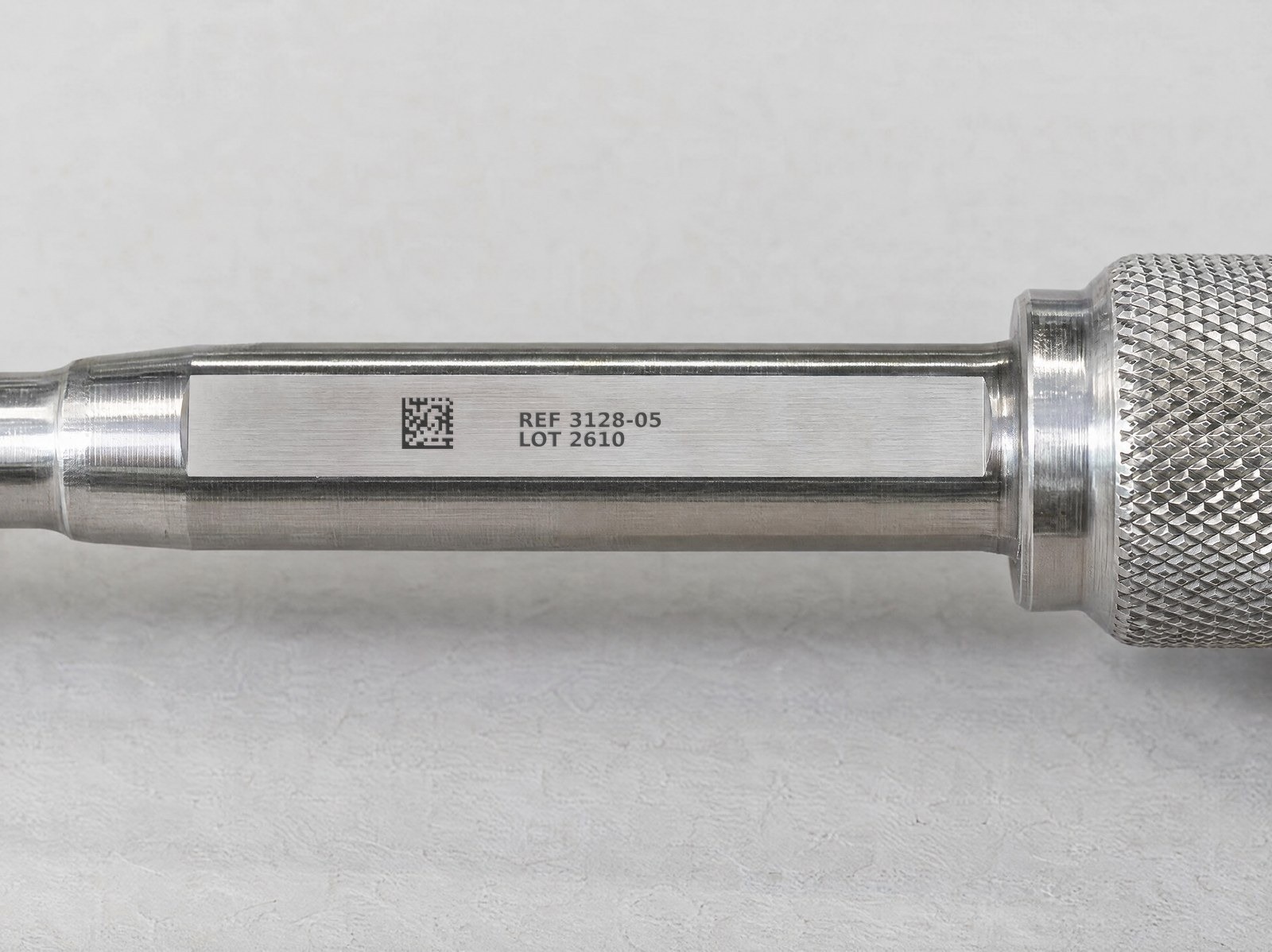
The choice between the two sources, therefore, is not an aesthetic one: it depends on what happens to the part downstream of the marking.
MOPA black: an oxide grown under heat
MOPA is a fibre source with an adjustable pulse: the ability to vary pulse duration and frequency is what allows it to control the heat input to the material. On stainless steel the black is obtained through controlled oxidation (annealing): the beam locally heats the surface without removing it, triggering the growth of an oxide layer. The colour we see is that of the chromium and iron oxide grown on the surface — the same principle by which, playing with the parameters, oxidation shades are achieved. It is a process that favours thermal control, as already discussed regarding MOPA compared to traditional fibre.
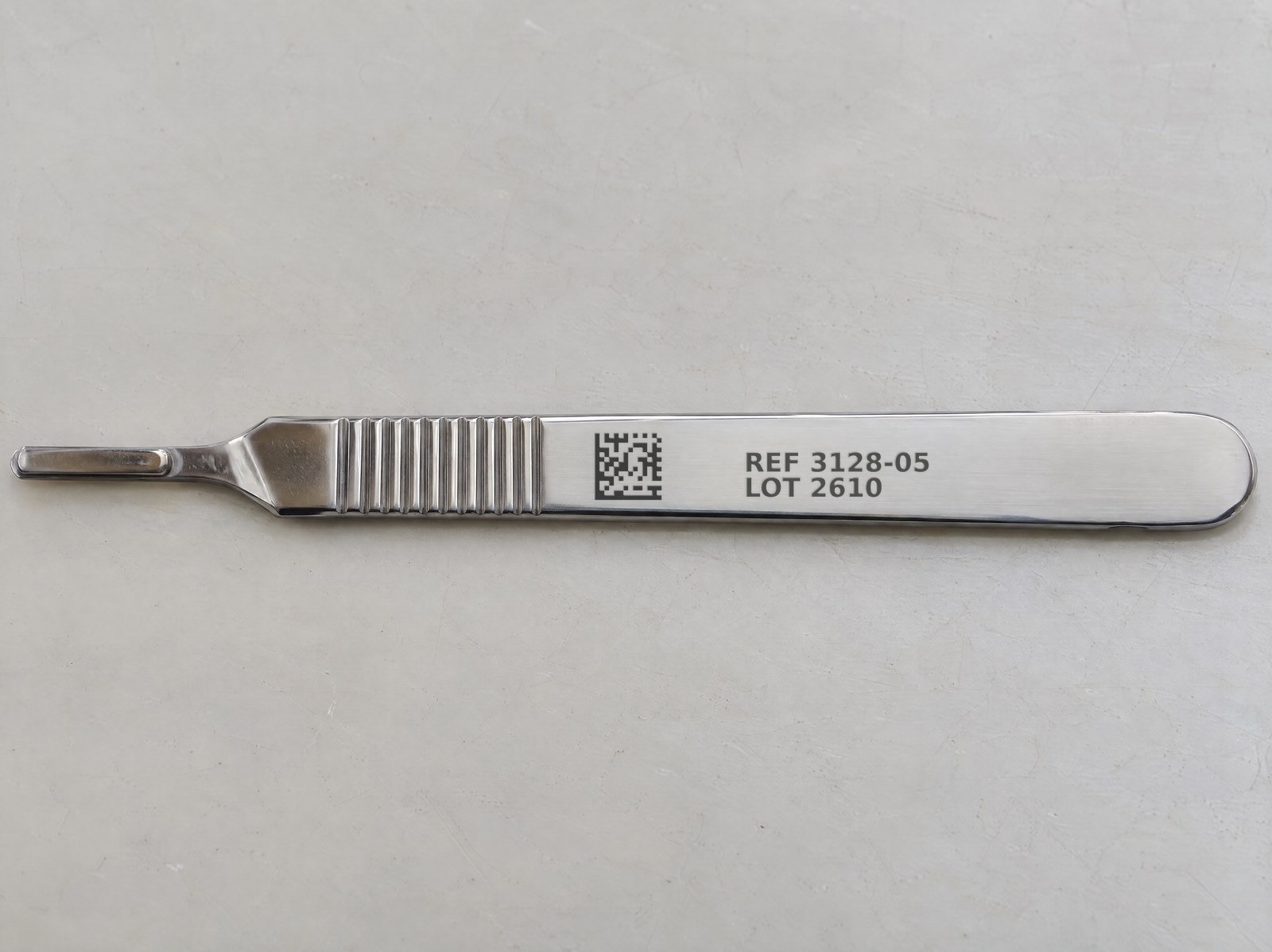
MOPA black has concrete merits: it does not remove material, it works on a wide range of metals and opens up the chromatic shades of annealing, a terrain akin to that of controlled oxidation on titanium. The limitation is not in the result at the end of marking, but in what that result is made of: a surface oxide layer.
Why passivation can attack thermal black
The passivation of stainless steel is, by definition, an operation that acts on the surface layers of the metal: citric or nitric acid dissolves the free iron and surface contaminants so that the passive chromium oxide layer can form. The problem is that MOPA black is precisely a surface oxide layer, that is, the very category of surface on which the passivation bath works.
It follows that, depending on concentration, temperature and immersion time, the acid can attack the oxide that makes up the black, thin it out or alter its structure: the mark discolours, loses depth, drops in contrast. This is not an automatic outcome — it depends on the type of oxide and the severity of the cycle — but it is a risk inherent in the fact that the colour coincides with a surface chemistry that passivation is designed to remove.
| Aspect | MOPA black (thermal) | Ultra-short pulse black |
|---|---|---|
| Origin of the black | Oxide layer grown on the surface | Surface micro-structure that traps light |
| Heat input | Present (controlled annealing) | Negligible |
| Behaviour in acid passivation | The oxide can be attacked | Topography not affected by the acid |
| Oxidation shades | Possible on metal | Not its purpose |
| Typical use context | No downstream passivation or aesthetic use | Passivation and repeated sterilisations |
The ultra-short pulse: black from structure, not from oxide
The ultra-short picosecond pulse radically changes the mechanism. The energy is transferred to the material in such a short time that the heat input to the surrounding area remains negligible — negligible, not nil: a small amount of heat is always present. This mode, often called cold ablation, does not grow an oxide: it removes and reorganises the material at the micrometric level, generating a self-organised surface micro-structure that traps the incident light.
It is that structure that produces the black: a deep, matt black, not iridescent, that maintains the same contrast from any viewing angle. It is neither a pigment nor an oxide, it is surface geometry — the same logic that makes the picosecond pulse the reference choice where reflection and mark stability matter more than peak speed.
Why structure withstands the acid better
Here lies the decisive difference for the medical sector. If the black is a surface topography and not an oxide layer, passivation has nothing «chemically its own» to dissolve: it removes the free iron and builds the passive chromium layer, but it does not erase the micro-structure that generates the colour. The heat-affected zone is reduced, there is no thick oxide to attack, and the marked surface remains essentially the re-shaped base alloy.
The practical result is that the mark goes into citric or nitric passivation and comes out substantially identical, and retains its characteristics even after repeated sterilisation cycles and salt spray tests. It is the same reason why 360° black marking on dental burs is entrusted to the ultra-short pulse when the cycle involves downstream chemical treatments.
Stable contrast and legibility over time
The stability of the black is not merely aesthetic: it is the condition for a DataMatrix or a UDI code to remain legible throughout the life of the device. A non-iridescent black guarantees a constant contrast regardless of angle and lighting, the prerequisite for good grading of the code — the quality assessment applicable in-line, distinct from the laboratory verification that requires controlled conditions.
On a polished cylindrical component, where reflection works against reading, a mark that discolours after passivation can cause the code to slip below the required grade threshold without anything in the marking process having changed. The resistance of the black to chemical treatment and its legibility over time are, in practice, the same requirement seen from two sides.
When MOPA is enough and when the ultra-short pulse is needed
The honest conclusion is that neither technology is «better» in absolute terms: they suit different scenarios. MOPA black is fully adequate — and more versatile — when the part does not undergo downstream passivation, when the chemical treatment is mild, or when the aim is aesthetic and one wants to exploit the oxidation shades. In these cases MOPA works on a wide range of metals and remains the most flexible choice.
The ultra-short pulse becomes a process choice, not a matter of taste, when the component goes into citric or nitric passivation, faces repeated sterilisation cycles or salt spray tests, and the black must remain permanent and non-iridescent on surgical stainless steel or titanium. In these cases the advantage is not the depth of the black at inspection — which both technologies achieve — but the fact that that black survives the treatment that makes the part fit for use. Before choosing, the right question is not «which black is more attractive», but «what will the acid do to this mark»: it is the answer to that question that points to the source.

Applications Manager | LASIT
Applications Manager at LASIT for over 20 years, Mario Palmieri oversees the management and development of the company’s laser laboratory. He is responsible for conducting sample tests for customers, supporting the automotive, medical, aerospace and electronics sectors in identifying the most suitable laser marking solution for their needs.