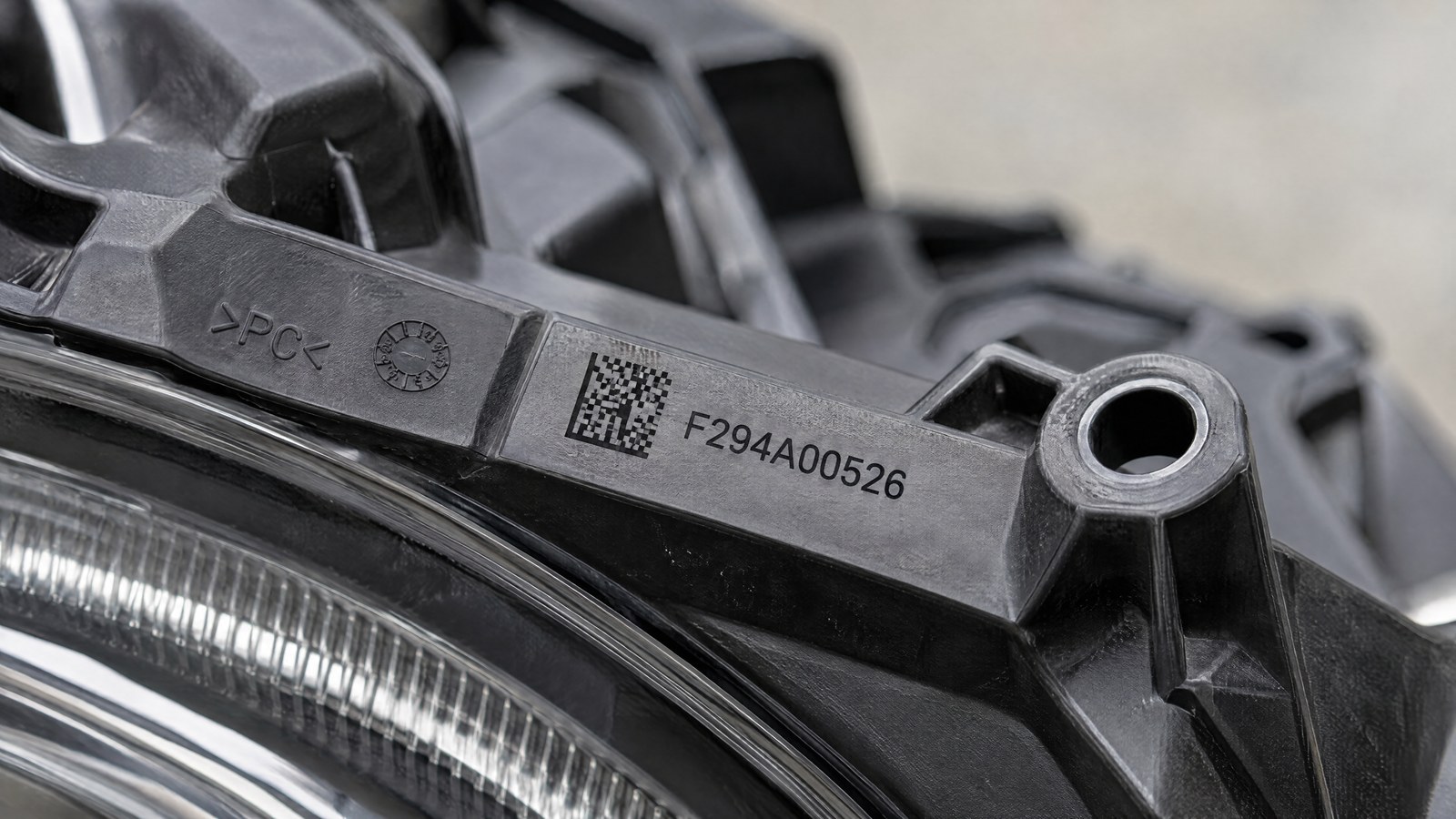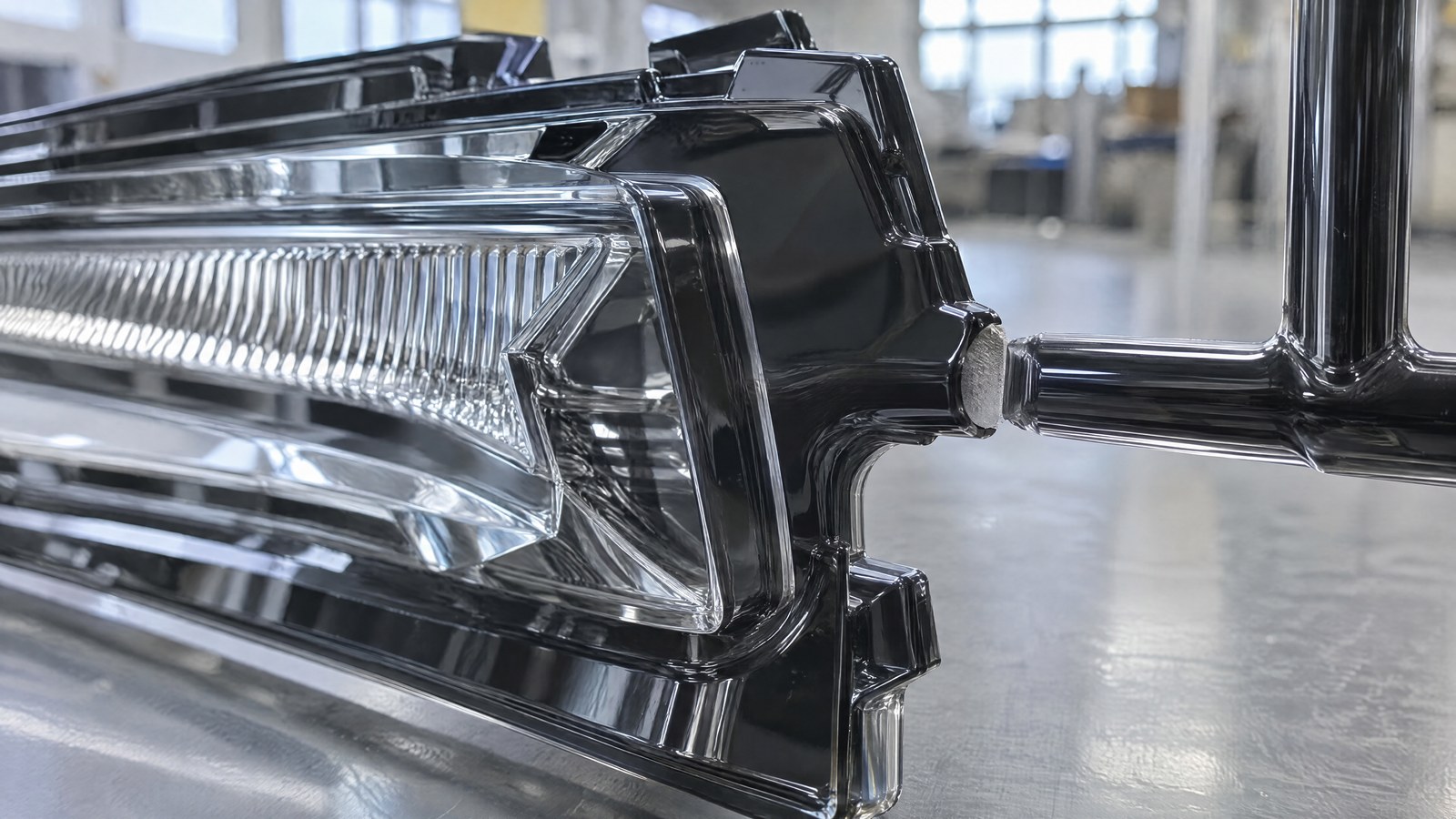
Anyone injection-moulding automotive components is familiar with the journey the sprue makes after the press: the part comes out of the mould with the feed channel still attached, is collected in a bin and taken to a separate workstation where an operator or a trimming press removes the gate. It is an operation that lives off-line, and like everything that sits off-line it adds handling, work-in-progress buffers and waiting times between moulding and finishing.
Bringing degating back downstream of the press, inside the same cell, is technically possible with the laser, which cuts the gate without contact. But doing so does not simply mean placing a source next to the mould: it means designing a cell that removes the sprue in the time the press takes to produce the next moulding, without becoming the bottleneck of the line.
The in-line degating cell rests on five design choices that must be decided together: how the part reaches the laser, how it is positioned, how the fumes are managed, how the station talks to the press and how the cut edge is inspected. None of these choices is independent of the others.
Why mechanical sprue cutting shows its limits
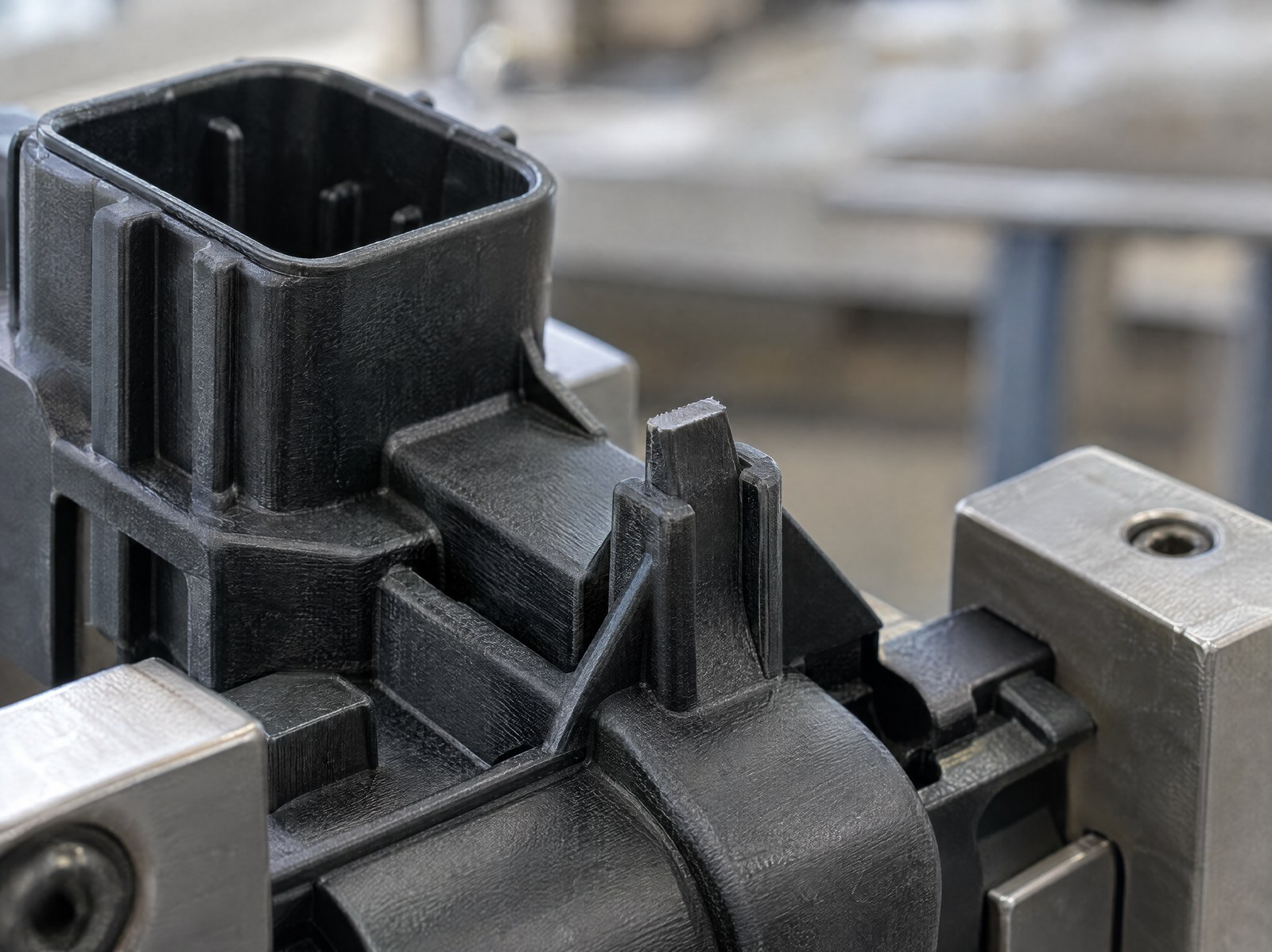
Mechanical trimming removes the gate with a blade or a gripper. It works, but it transfers a cutting stress to the part, and on rigid or brittle materials — reinforced engineering polymers, polycarbonate, the PMMA of optics — that stress turns into microcracks starting from the gate point, into burrs and into a residual edge that varies from part to part as the tool wears. On an aesthetic or optical component, where the gate is close to a functional surface, these defects become scrap.
The laser works differently: it ablates the material at the gate point with no mechanical force on the part. The result is a repeatable separation line, with a clean, defined edge that does not depend on the sharpness of a blade. On delicate geometries the advantage is not theoretical: it is the absence of the stress that generates cracks. Anyone wishing to explore the principle of cutting the gate with the beam can start from the article dedicated to degating and sprue removal, which describes its physics.
Staying within the press cycle time: the constraint that decides everything
The parameter that governs the whole cell is the moulding cycle time. The press produces a moulding at regular intervals, and the degating cell must complete its own work — pick-up, cut, unload — within that window, otherwise it slows the press down. This is why an in-line cell is not designed starting from the laser, but from the rhythm of the machine it hooks onto.
The principle that makes this manageable is masked time: while the press closes the mould and injects the next cycle, the robot and the laser station work on the moulding just extracted. Degating is not added to the moulding time, it is hidden within it. When the window is tight, the sequence is optimised by reducing the robot’s movements and bringing the beam to the gate point with the scanning head, without moving the part.
The cell’s sequence within the press cycle timeRemoval from the mouldRobot pick-upSprue cuttingFume extractionEdge inspectionPick-up and positioning: where repeatability is decided
Laser cutting is only as repeatable as the position of the gate point in front of the beam. This is where robotic handling comes in: the gripper collects the moulding just extracted and brings it to the station, or holds the part while the head works. In both cases the gate geometry must present itself to the laser always in the same spot, because a gate that shifts by a few tenths relative to the focus produces an incomplete cut or a residue.
For this reason the gripper and the tooling are designed around the specific part, referencing stable areas of the moulding — not the gate itself, which is precisely what has to be removed. In cases where the mould family changes frequently, the reference can be recovered with a vision system, so that the station locates the gate even in the face of small variations in the part’s position in the gripper.
Fume extraction and optics protection
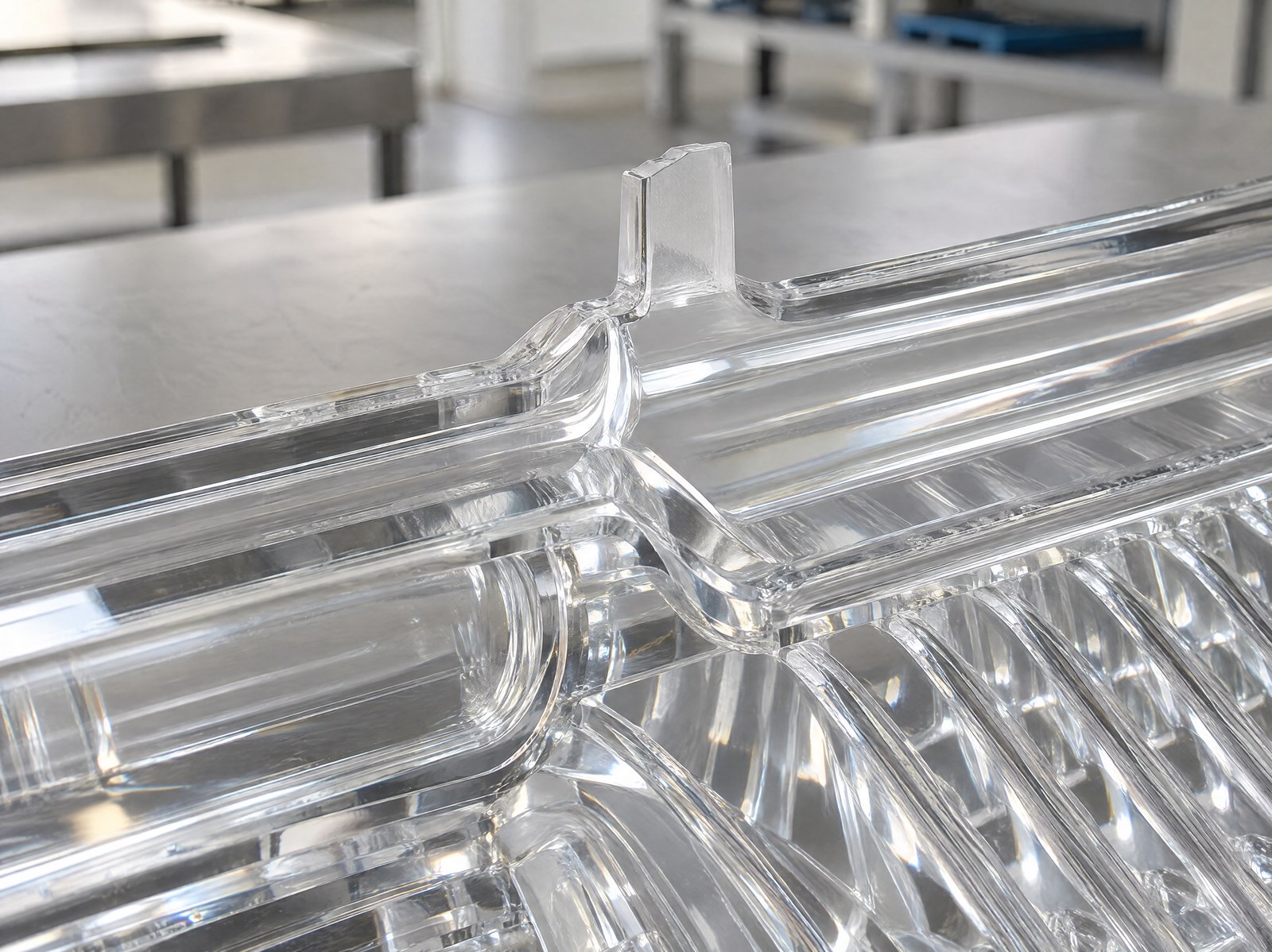
Cutting a polymer with the laser generates fumes and particulate. In an enclosed cell, if they are not captured the moment they form, those products settle on nearby surfaces and on the lens of the head, degrading cut quality over time. On transparent optics the problem even has a precise name: the condensation haze that can veil the surface around the worked point, the so-called foggy effect, which on automotive lighting components is an unacceptable aesthetic defect.
The countermeasure is a fume extraction system sized and aimed at the cut point, with a flow that draws the particulate away from the worked zone and from the optics rather than merely refreshing the air in the cell. It is a detail that decides the consistency of the process over tens of thousands of parts: effective capture keeps the lens clean and stabilises the cut quality, whereas a generic extraction lets quality slowly slip cycle after cycle.
Synchronisation with the press: the handshake that holds the cell together
An in-line cell is not a station working on its own: it is a node that exchanges signals with the press. The moulding controller communicates when the mould is open and the part available; the cell confirms it has taken charge, carries out the operation, and signals when it is free for the next cycle. This dialogue — the handshake between the two controllers — is what ensures that robot, laser and press never clash on timing.
In terms of integration, the laser station behaves like any other automated island on the line and hooks onto the factory systems through standard industrial protocols. The same approach with which LASIT integrates marking and downstream checks of a press into a single cell is described in the case of the FlyPress cell for automotive turbochargers, where the laser and the testing station coexist in a single synchronised cycle.
In-line edge inspection
The final element is verification of the result. At an off-line workstation the check is often visual and on a sample basis; in-line it is best made part of the cycle, with a vision system that inspects the gate area immediately after the cut and verifies that the sprue has been removed correctly and that the edge is intact. A part that fails the check is scrapped before moving on, so the defect does not propagate downstream.
This check remains a geometric and aesthetic verification of the edge, and must not be confused with a laboratory validation: it serves to keep the process within the limits set during set-up, cycle after cycle, and to give the line an objective data point on every part worked.
Who it is intended for (and who it is not)
The integrated laser degating cell makes sense where volume is continuous and off-line degating is already a bottleneck: series moulding of automotive components, optics and aesthetic components where mechanical cutting leaves cracks or burrs, parts where the gate is close to a functional surface. In these cases bringing the operation back inside the cell removes handling, buffers and the variability of manual cutting.
It is not, however, the obvious choice for low-volume production, for very large gates on tough materials where a robust trimming press does its job without penalising the part, or for mould families so heterogeneous as to make repeatable tooling impractical. In those contexts a dedicated workstation, even off-line, remains the most sensible solution. The laser pays off when the edge has to be clean and repeatable, when the material suffers under mechanical stress and when the rhythm of the press demands that the flow not be broken.

Business Development Director | LASIT
Business Development Director at LASIT, Giandomenico Ievoli is responsible for the commercial direction and strategic development of the company. He leads business development activities at national and international level, contributing to the growth and expansion of LASIT in global markets.