

Anyone running a gravity die-casting foundry or a die-casting operation with permanent (chill) moulds knows the moment when the cavity stops “giving back” the part the way it should. Casting after casting, three different deposits build up on the surface of the tool steel used for the mould: the polymerised release agent, which the thermal cycle bakes and turns into a tenacious film; the oxides generated by repeated exposure to molten metal; and the carbonaceous deposits left behind by degraded lubricants and release agents. The result is a cavity that loses definition on the detail, alters the finish of the casting and, in the worst cases, encourages filling defects or soldering.
Maintenance today almost always follows one of two routes: solvent degreasing, which softens but does not strip the polymerised layer, and micro blasting, which does remove it but acts abrasively across the whole surface. In both cases the maintenance team pays three prices: the progressive wear of the geometry (every pass of abrasive also removes a fraction of the substrate and rounds off edges and micro-detail), poor repeatability (the result depends on the operator’s hand and on the day’s grit size) and machine downtime, because the mould often has to be dismantled, taken to the blasting cabinet and brought back up to temperature.
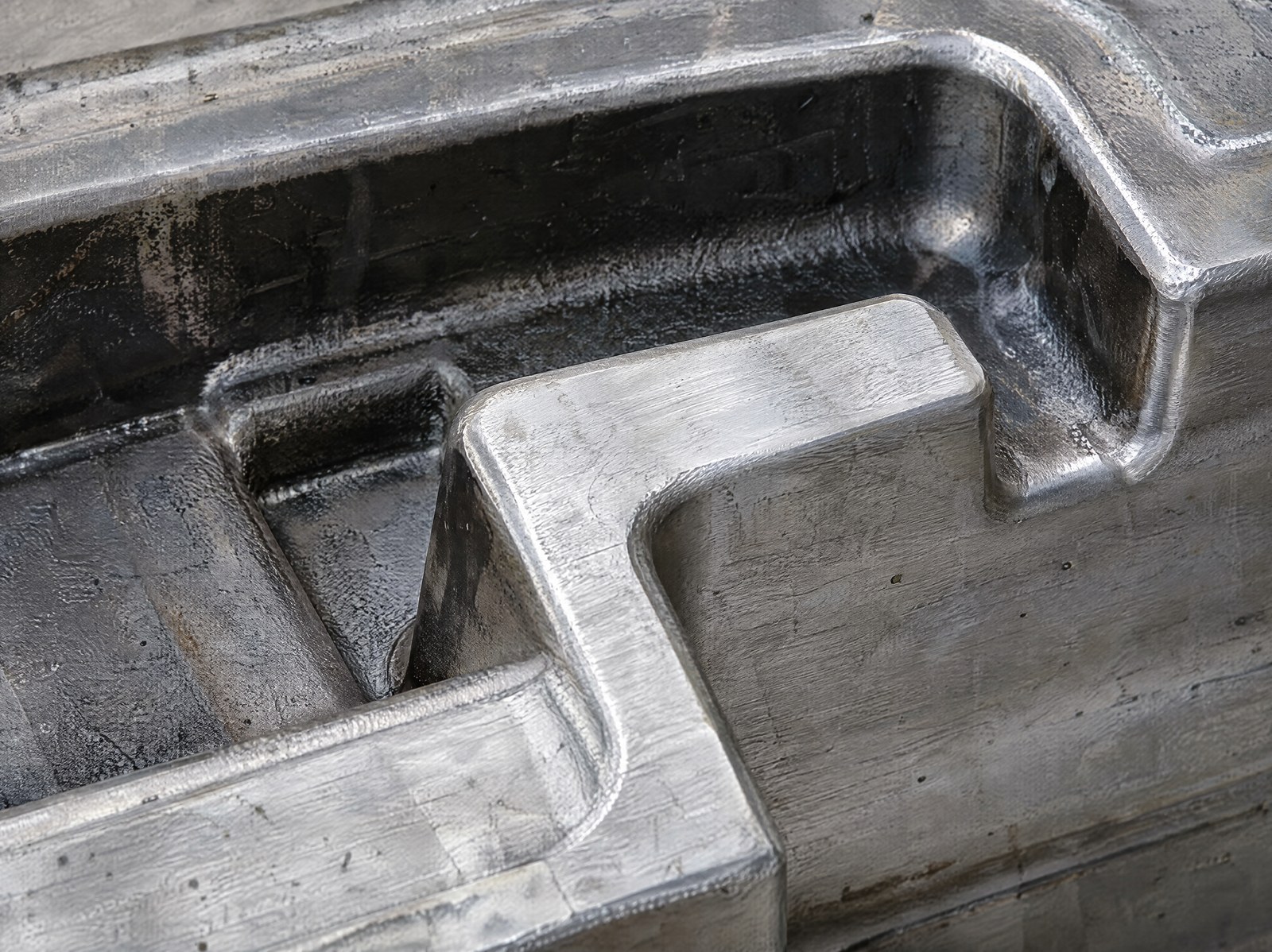
Laser cleaning tackles exactly these three points: it removes the contaminant by selective ablation, without touching the steel underneath, and it is a repeatable, programmable process — therefore suited to planned preventive maintenance rather than corrective maintenance.
Why release agent, oxides and carbonaceous deposits behave differently
Not all cavity contaminants are the same, and the choice of cleaning method should start from here. The release agent, sprayed on at every cycle, polymerises and layers up under the repeated heat: from a thin film it becomes an adherent crust. Oxides are chemically bonded to the surface iron and tend to form in the corners and in the areas in most direct contact with the melt. Carbonaceous deposits, finally, are dark and strongly absorbent to infrared radiation. It is precisely this difference in behaviour that makes the laser interesting: contaminant and steel have different interaction thresholds with the beam, and selectivity is built on that difference.
How selective ablation works
Laser cleaning works by ablation: a pulsed beam, typically from a fibre source with a wavelength of 1064 nm, is focused and scanned across the surface. The contaminant absorbs the pulse energy and is removed in an extremely short time — vaporised or ejected as micro-plasma — without the heat having time to propagate deep into the metal.
The principle that makes the process “clean” is the ablation threshold: every material only begins to be removed above a certain energy density (fluence). Polymerised release agent, oxides and carbon have a markedly lower threshold than tool steel, and they absorb infrared far better. By setting the parameters just above the contaminant’s threshold and below that of the substrate, the beam “consumes” the unwanted layer and stops naturally when it reaches the clean metal, which reflects most of the residual energy. In practice the laser removes what it needs to remove and leaves the rest intact, with no mechanical contact and no abrasive consumables. The operating parameters — average power, frequency and scan speed — have to be tuned to the type of deposit and to the steel.
Why selectivity preserves the cavity’s roughness and dimensions
This is the point that matters most to a tooling manager. Micro blasting, being an impact process, acts indiscriminately on contaminant and substrate: it removes the deposit but blunts the edges, opens up the roughness and, repeated over time, shifts the cavity’s dimensions out of tolerance. In a precision mould this means losing the definition of the ribs, lettering and radii that characterise the casting.
Laser ablation, acting only on the layer that absorbs the energy, is not abrasive: it does not remove base metal, so the cavity’s roughness and dimensions stay as designed. The surface that re-emerges is the steel’s original one, not a new finish created by the abrasive. This also makes it possible to treat only the contaminated areas selectively, without touching areas that are already clean — something impossible with a jet of abrasive that hits the whole surface. For a broader comparison between the two process philosophies, we have devoted a dedicated article to laser cleaning as an alternative to blasting.
Repeatability: from corrective to scheduled maintenance
The least visible but most strategic advantage is repeatability. A laser cleaning recipe is a set of saved parameters: scan path, number of passes, power and speed. By recalling the same recipe, cleaning no. 500 is identical to no. 1, regardless of the operator. This turns an operation done “by feel” today into a measurable, documentable process that fits well with a preventive maintenance logic at defined intervals: every so many casting cycles the mould receives its scheduled cleaning, before the deposit becomes critical.
This also brings a reduction in consumables: no abrasives to buy, store and dispose of, no solvents to manage as waste. The laser has no consumable material that touches the mould, and the only recurring service is the extraction of ablation fumes. We apply the same selective-removal philosophy, with different parameters, to the removal of rust and oxides on cutting tools.
A concrete example: polymerised release agent on a mould steel cavity
A typical case is that of a tool steel permanent mould with the cavity covered by a dark film of polymerised release agent and a veil of oxide in the hottest corners. With micro blasting the toolmaker obtained a “clean” surface but one that was gradually more matt and with ever less crisp micro-detail. With laser cleaning the beam scans the cavity and selectively removes the film and the oxide, letting the steel emerge with its original finish; the cavity’s edges and engravings stay defined because the base metal is not touched. The treatment time depends on the thickness and extent of the deposit. This type of application is a close relative of those LASIT has long handled in the foundry environment, as illustrated in the articles on laser marking on moulds and on marking hot foundry parts.
Who it is designed for (and who it is not)
Laser cleaning is at its best where the deposit is thin or of medium thickness and spread over accessible surfaces: polymerised release agent, oxides and carbonaceous patinas on the cavities of permanent moulds and tool steel die-casting equipment, where preserving the geometry and the repeatability of the result matter. It is the natural choice for anyone who today suffers the wear of micro blasting or the ineffectiveness of solvents on the polymerised layer, and for anyone who wants to structure a planned preventive maintenance programme instead of a corrective one.
It is not, however, the best answer in every case. On very thick, layered contamination the laser has to proceed over several passes, and the cycle time can grow to the point where a preliminary rough removal by other means becomes more worthwhile. On very deep, narrow or geometrically complex cavities, where the beam cannot reach perpendicularly or at the right focal distance, dedicated access, heads with additional axes or multiple set-ups are needed, and in some cases the cost/benefit ratio does not hold up. As always, the honest assessment is made on the real part: it is the thickness of the deposit, the depth of the cavity and the accessibility that tell you whether the laser is the right route or only one part of the maintenance process.

Senior Applications Support | LASIT
Senior Applications Support at LASIT for over 10 years, Ciro Ventura is a specialist in laser marking applications for laboratory sample testing. He supports customers and technical teams in evaluating and selecting the most suitable laser solution for their needs.


