

On the front panel of a washing machine, an oven or a hob, the control symbols must behave in two opposite ways on the same part. By day, with the surface off, they are discreet marks on a plastic of uniform colour; by night, or with the control switched on, they light up from behind with a crisp, even glow. This is the day&night principle, and on a household appliance it is no aesthetic flourish: it is how the user reads the panel and how the panel performs its function.
For anyone industrialising these front panels, the margin between “legible” and “reject” is thin and partly subjective. A symbol that at night shows haloes, frayed edges or a brightness different from the one next to it makes the panel inconsistent; a symbol that by day “bleeds through” breaks the neutral surface. And all of this must stay identical from the first to the last part across batches of tens of thousands.
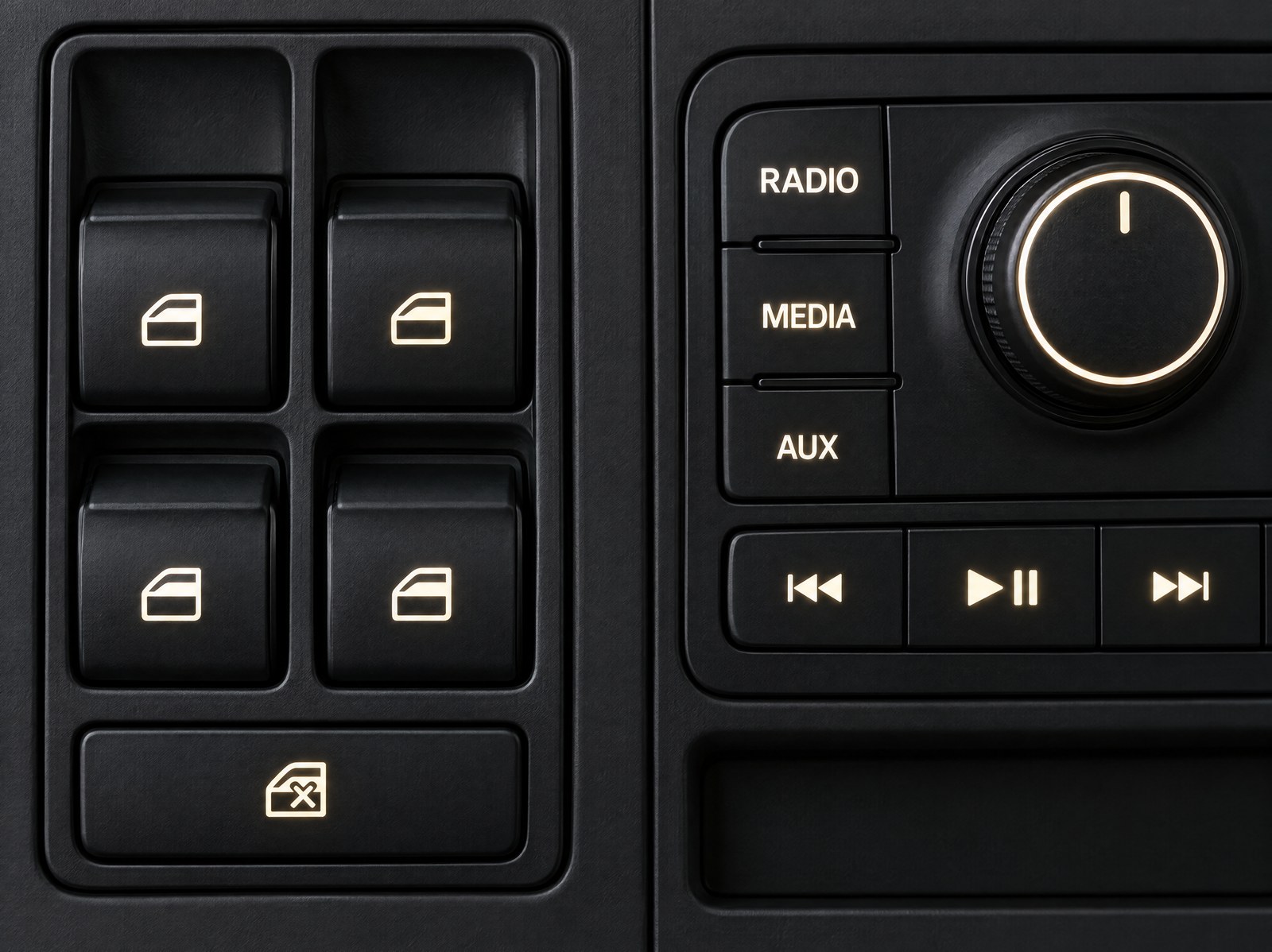
Day&night laser marking addresses exactly this problem: it does not add a mark on top of the plastic, but selectively removes the layer that hides the light. The marking thus becomes the very function of the product.
When the marking is the function of the product
In most applications the marking tells the story of the part: a logo, a code, a batch number. With day&night something different happens. The symbol does not describe the panel, it makes it work: where the laser acts the light passes through, where it does not the surface stays blind. The design of the marking and the optical behaviour of the product coincide.
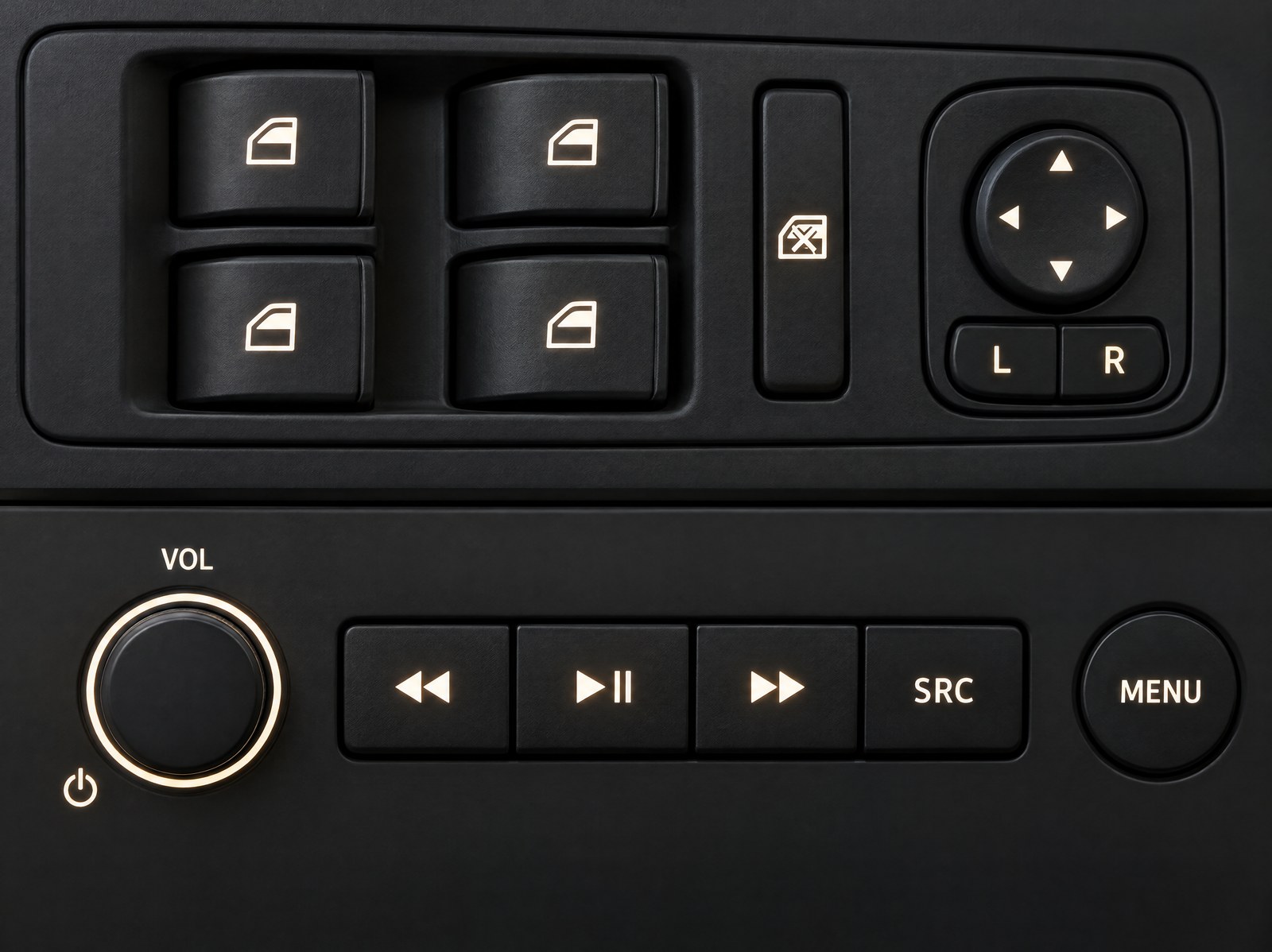
It is the evolution of an approach LASIT has described for some time. Compared with what was explained in the article Day & Night Laser Marking, the point today is no longer simply to show that the laser can “open up” a backlit symbol, but to govern its optical quality layer by layer and its repeatability at industrial volumes. This is the leap that matters to anyone taking a front panel from prototyping to series production.
Selective ablation: removing the paint, not the base
The day&night part is built up in layers. Underneath there is a translucent substrate, typically an engineering polymer such as polycarbonate, able to let the light through. On top there are one or more opaque paint layers, which by day make the surface uniform and covering. The symbol is created by removing the paint exactly where the light must pass, without affecting the translucent base below.
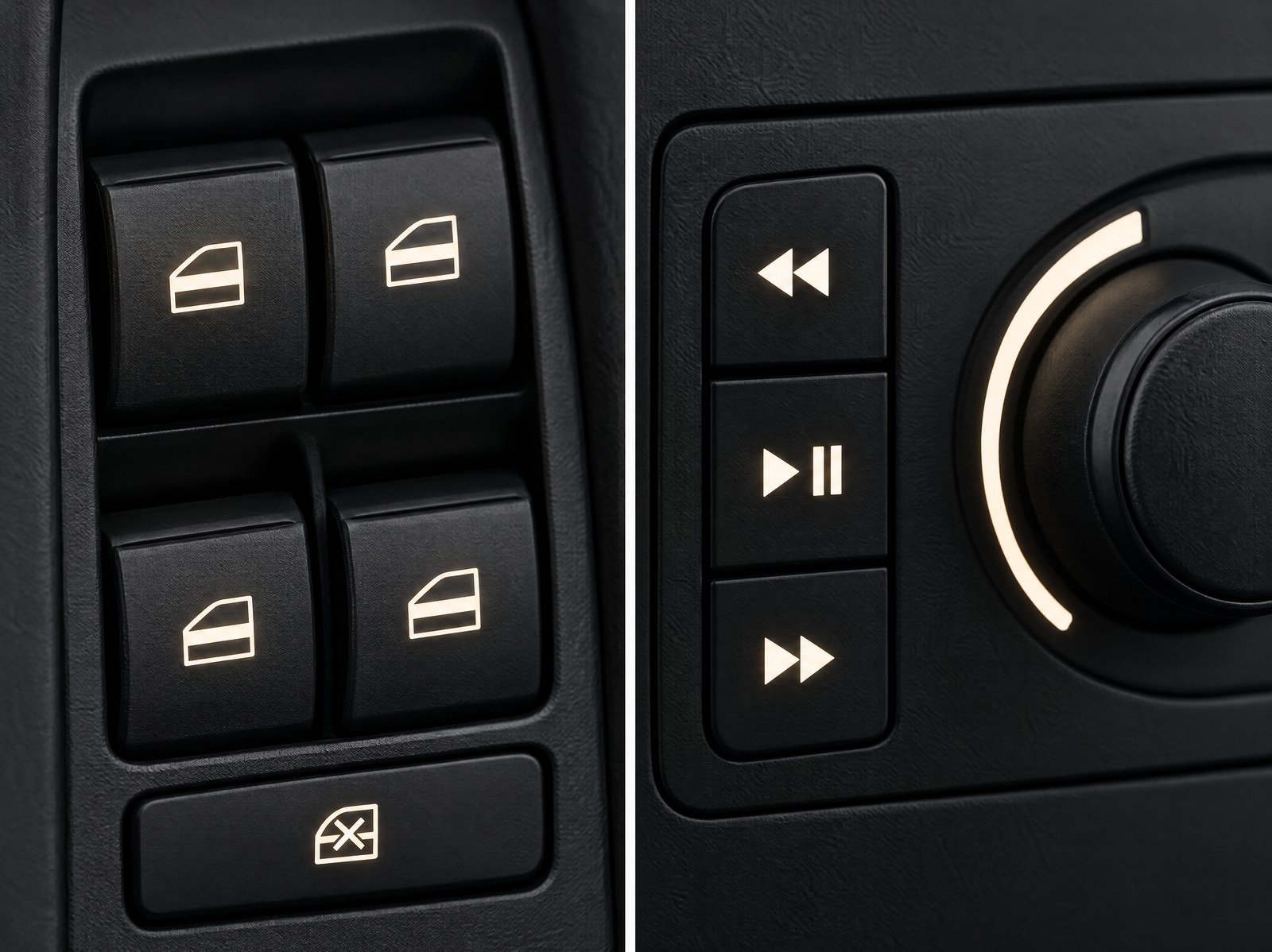
For this to work you need a source that attacks the coating and not the support. The UV source at 355 nm is particularly well suited to painted plastics: the ultraviolet wavelength is absorbed intensely and superficially, and the process is predominantly photo-ablative, with limited heat input. Compared with fibre at 1064 nm or CO₂ at 10.6 µm, the interaction stays concentrated on the paint layer, the necessary condition for opening the symbol without deforming or clouding the polycarbonate that must remain clear.
How a day&night symbol is madeTranslucent baseOpaque layerSelective ablationUniform lightTransmittance control: even light by night, neutral by day
The perceived quality of day&night depends on how much paint is removed and how gradually. You do not always go all the way down to the base: often the aim is to bring the residual thickness of the coating within a precise window, so that the light filters through diffuse and even rather than patchy. On multi-layer stacks — for example a covering base beneath a coloured finish — removal has to be managed layer by layer, because each layer has a different optical behaviour.
Governing transmittance means working on the energy deposited per unit of surface and on the number of passes, not on a single “threshold” shot. This is why day&night is laboratory work before it is line work: you define the ablation recipe that gives the desired luminous yield, freeze it in the FlyCAD management software and repeat it part after part.
Paint removed Light transmitted Below threshold it stays blind, beyond it the light turns uniformCrisp edges: legibility in both conditions
A backlit symbol is only as legible as its outline. A frayed edge, with micro-burrs of paint or a wide transition zone, produces a luminous halo by night and a dirty line by day. The advantage of the laser lies in the small spot size and in the control of the affected zone: the outline of the symbol stays defined and repeatable, without the smearing typical of processes that remove material less selectively.
Edge crispness is also what holds the dual day/night reading together. The same outline that defines the light by night defines the neutral mark on the painted surface by day: a single process must satisfy both conditions, which is why the acceptance criterion has to be checked in both, not only with the panel lit.
Batch-to-batch aesthetic repeatability and reference sample
On an isolated panel almost any process gives a good result. The difference shows on the batch: the industrial challenge of day&night is that the ten-thousandth symbol should be indistinguishable from the first, and that the panel produced in March should match the one from November. This depends on the stability of the source, on repeatable fixturing of the part and on the ablation recipe staying locked and traced.
The reference is not a number, it is an object: the approved reference sample, that is the panel validated with the customer and the quality department that sets the luminous yield, the tone of the mark by day and the edge crispness deemed compliant. Each batch is compared with that master, under controlled lighting conditions. It is the kind of check LASIT structures in its own quality test laboratory for home appliances, where the recipe is fine-tuned and validated on real samples before entering production.
Many front panels, moreover, are not flat: on curved or raised surfaces correct focusing across the whole area is itself a factor of uniformity. Systems with three-dimensional scanning such as POLARIS are designed to keep the yield of the symbol constant even on shaped front panels, where a focus drifting at the edges would translate into a symbol lighter or less defined than at the centre.
Soft-touch coatings: the constraint that dictates the parameters
Premium front panels often adopt soft-touch finishes, pleasant to the touch but thermally delicate: these are coatings that tolerate heat poorly and that, under excessive energy input, tend to yellow, become glossy or shrink along the edge of the symbol. It is precisely these materials that dictate the process parameters.
The technical route is to keep the deposited heat low and controlled, exploiting the surface absorption of the ultraviolet and spreading the ablation over several light passes rather than concentrating it. It is the same principle of selective coating removal that LASIT applies in other fields, such as decoating in automotive lighting: removing the intended layer while leaving intact what lies beneath. The practical rule is that the panel finish does not adapt to the process, but the process is tailored to the finish.
Who it is designed for (and who it is not)
Day&night laser marking is the natural solution for anyone producing front panels and control panels for painted-plastic household appliances, with backlit symbols that must be legible both by day and by night, uniform and repeatable across large runs. It is all the more suitable the more the aesthetic yield is a quality criterion and not a detail, and the larger the batches: that is where the repeatability of the process and comparison with the approved sample make the difference against less controllable methods.
It is not, on the other hand, the right answer when the symbol does not need to be backlit but only to appear as a stable mark on non-layered plastic, or when the requirement is a functional traceability code: in those cases more direct marking solutions apply. And it remains a process that calls for a preliminary study of the paint-substrate stack: without first defining the recipe and the reference sample, the yield cannot be governed. For a broader picture of the configurations dedicated to the sector, LASIT describes its approach to custom laser systems for home appliances.

Applications Manager | LASIT
Applications Manager at LASIT for over 20 years, Mario Palmieri oversees the management and development of the company’s laser laboratory. He is responsible for conducting sample tests for customers, supporting the automotive, medical, aerospace and electronics sectors in identifying the most suitable laser marking solution for their needs.


