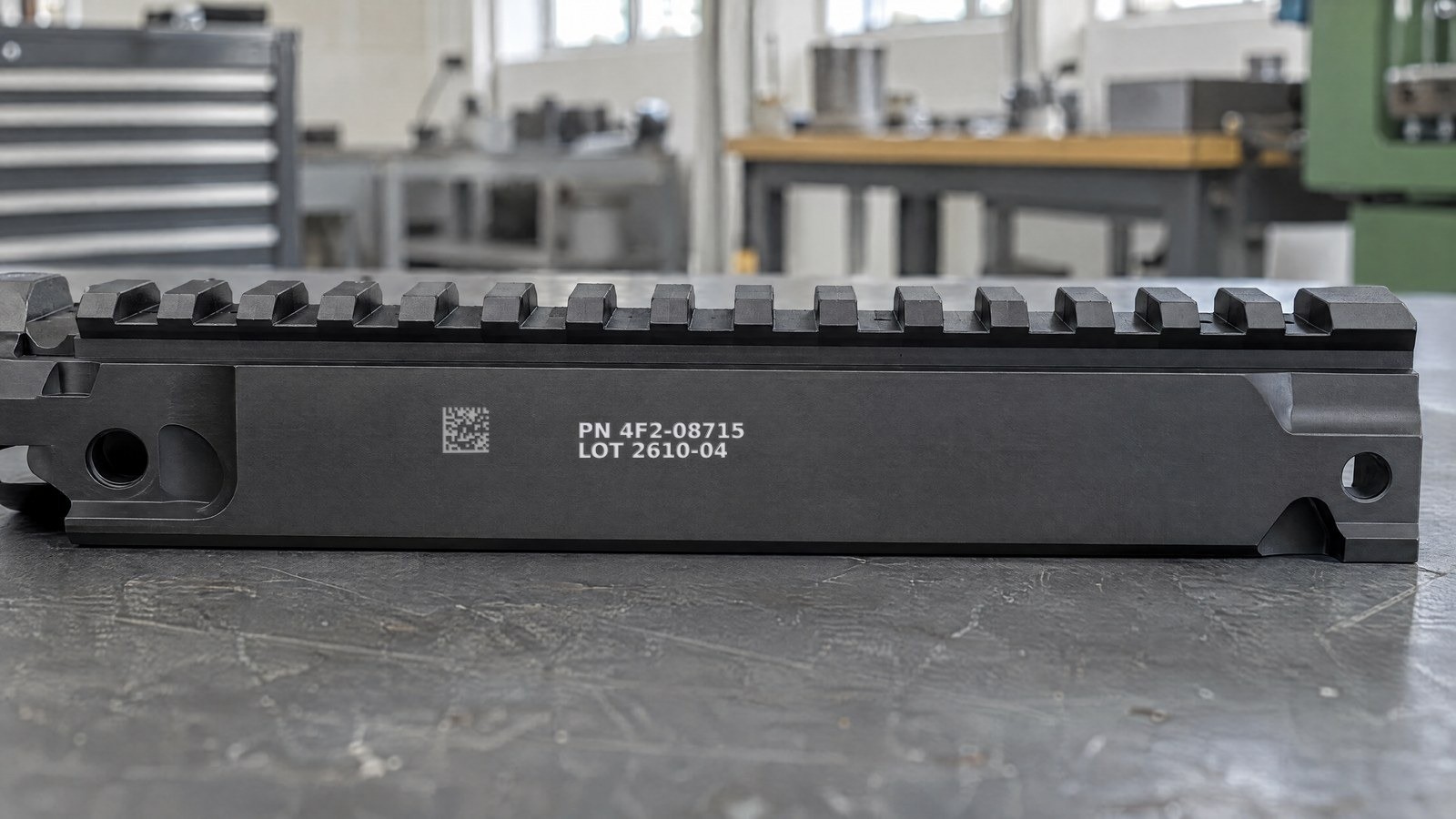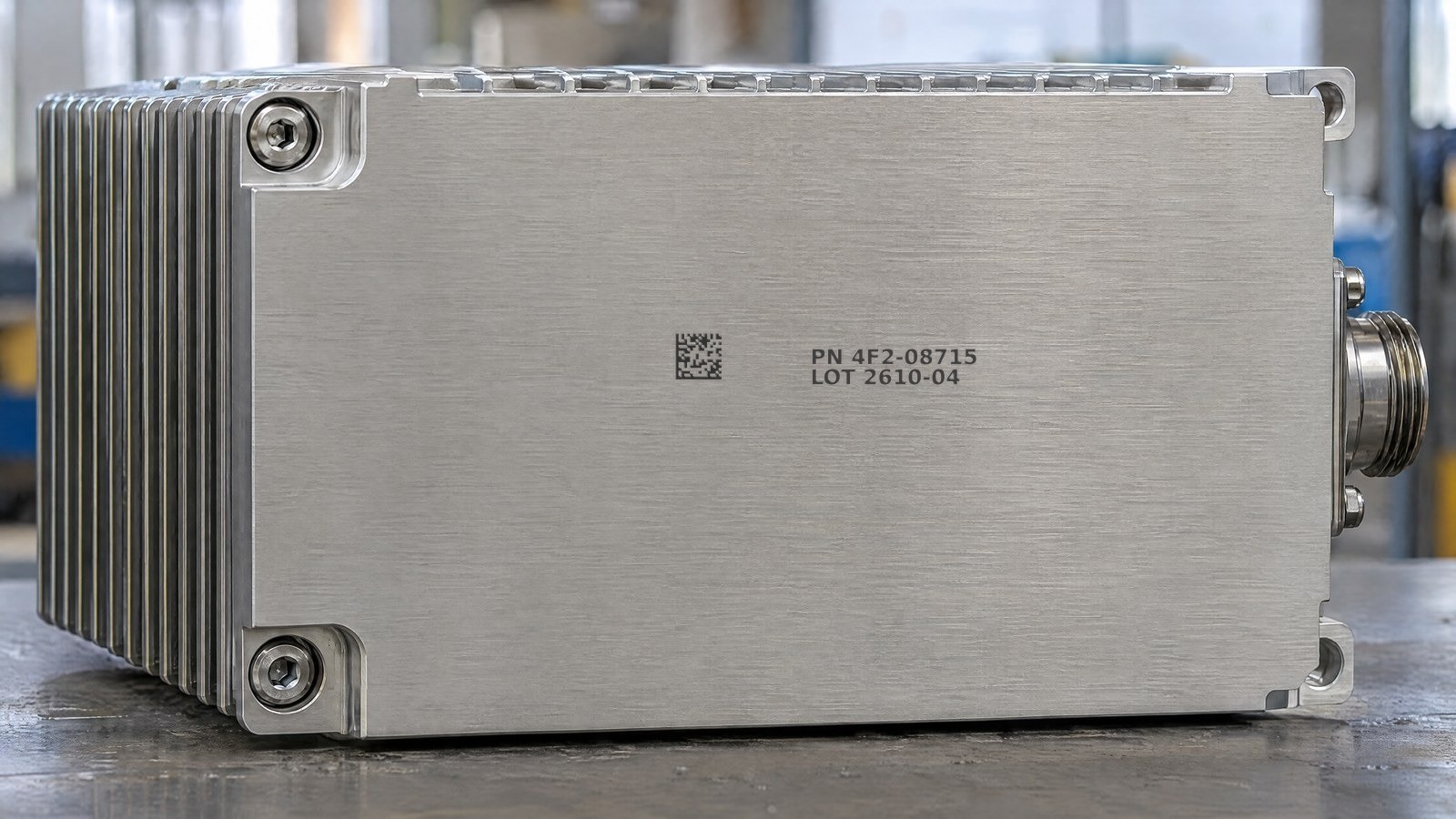
A precision machine shop that for years has turned and milled components for the automotive or hydraulics sectors receives its first order from a contractor in the defence supply chain. The drawing is familiar, so are the tolerances, and the machine tool is the same as ever. What changes is the marking specification: a stamped part number or an inkjet code on the crate is no longer enough. Every single piece must have a unique identity, that identity must remain legible for the entire life of the component, and it must be recorded so that it can be traced years later.
This is the leap that many mechanical subcontractors face when they enter a defence supply chain: the part stops being an indistinct batch and becomes an individually tracked object. Entering this supply chain does not mean changing the machine tool, it means treating the marking — and the data it carries — with the same rigour applied to holding a critical dimension.
From batch to piece: serialisation as a requirement
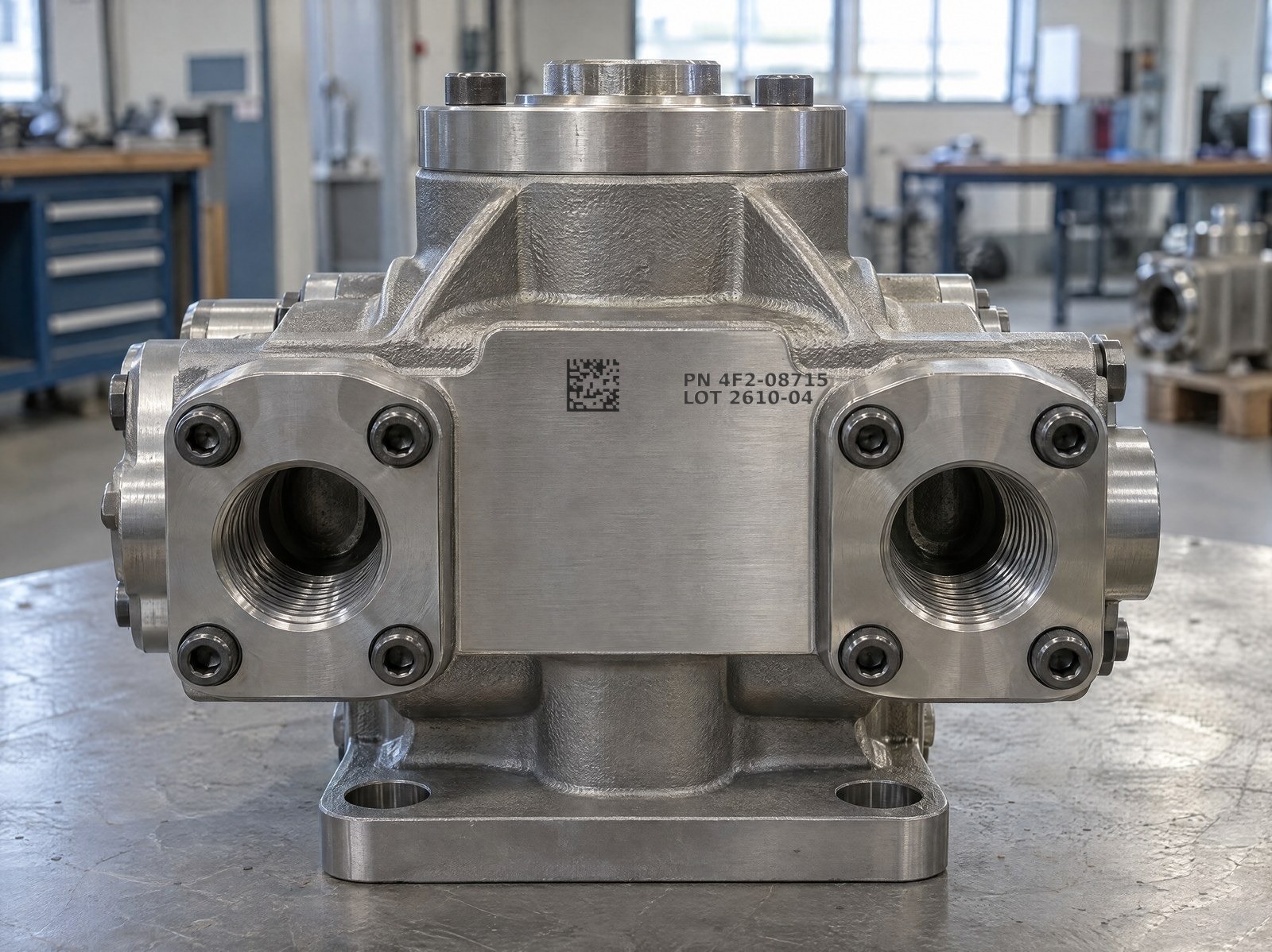
The first change is serialisation. In volume engineering it is normal to identify a batch; in defence the unit of traceability is the single component, which receives a unique sequential serial, almost always accompanied by a DataMatrix that holds the same data in scanner-readable form, plus the product reference and the batch in plain text alongside.
This shifts the centre of gravity from the applied nameplate to the piece itself. Direct marking of the component — so-called direct part marking — removes the weak link of the label that peels off or the tag that gets lost, and binds the identity physically to the material. It is the same logic that governs the unique identification of aerospace components, where every critical part must be traceable back to its own production history.
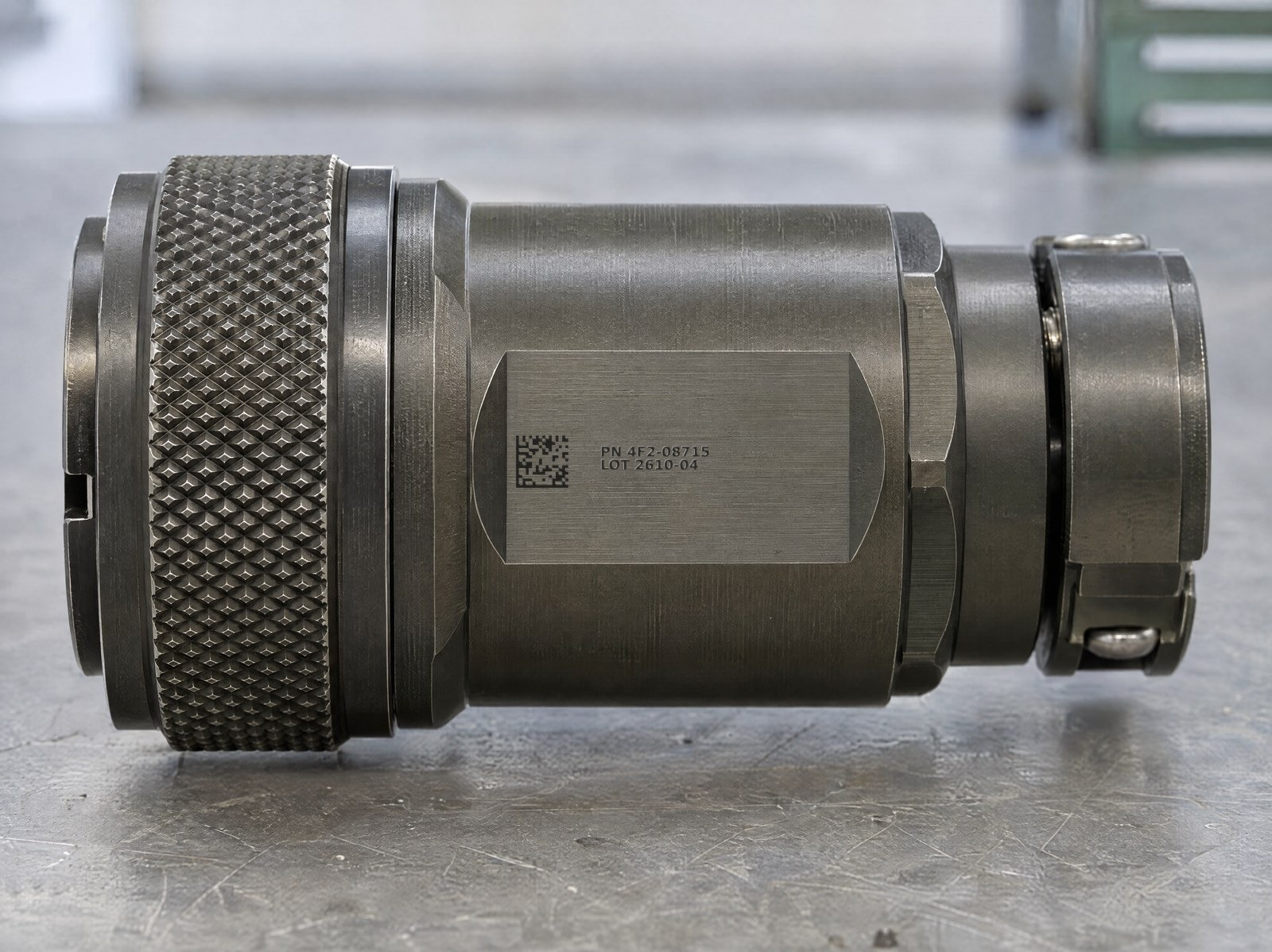
The laser is well suited to this task because it engraves a small, sharp and permanent code on a machined metal surface without adding material and without exerting pressure on the piece, a useful condition when the component is already at its finished dimension and allows no deformation.
The permanence of the mark through the life cycle
A serial has value only if it survives everything the component goes through. Parts destined for weapon systems and vehicles have long life cycles and harsh environments: surface treatments, oils and greases, repeated handling, thermal excursions, aggressive cleaning. A marking that is erased after the first treatment undermines the entire traceability chain.
Here the physics of the laser offers two complementary routes. Annealing — the controlled oxidation beneath the surface of steels and titanium — produces a dark mark that does not remove material and remains intact where a raised mark would be eroded or filled in by treatments. Where maximum optical contrast is needed instead, ablation is used, removing a thin surface layer. The choice between the two is not aesthetic: it depends on the material, the subsequent treatment and the conditions in which the code will have to be read.
Guaranteed legibility: in-line grading
In defence the marking must not only exist, it must be read with certainty by whoever retrieves it downstream. For this reason, alongside the marking comes grading: an automatic assessment of code quality carried out in-line, immediately after engraving, which measures contrast, cell regularity and edge definition, and rejects anything that does not reach the required threshold.
It is important to distinguish two things that are often confused. In-line grading is a process control, integrable into the marking cycle; the formal verification of a code is instead a laboratory operation, carried out under controlled lighting and optical conditions. For a subcontractor marking in production, in-line grading is the tool that intercepts the doubtful code before the piece moves on, especially on difficult surfaces such as shiny, curved or already-treated metals.
From serial to enterprise systemSerial generationDirect markingIn-line gradingData loggingBack to ERP/MESThis control logic is the same one that makes traceability with laser marking reliable in any regulated sector: a code that is marked but illegible is, for supply-chain purposes, a code that does not exist.
From the piece to the database: managing the data
The engraved mark is the visible part of a process that is first and foremost data management. The marking software generates the sequential serial, composes it in the data field together with the product reference and batch, converts it into a DataMatrix and keeps track of what has been marked. Every piece that leaves the station must leave a record behind it: which serial, on which component, with which parameter recipe.
For a workshop that previously handled marking as a silent operation, this is the deepest cultural change. It is not a matter of stamping a number, but of governing a numbering scheme: avoiding duplicates, maintaining the sequence, being able to demonstrate retrospectively that a given serial corresponds to a given batch of material. The laser marking of defence components such as ammunition lives precisely on this rigour in managing variable data.
Integration with company systems
The marking data neither originates nor ends in the laser station. In the most mature configurations the serial comes from the ERP or the MES, which assigns the numbering and receives back confirmation that marking has taken place, closing the loop between order, physical piece and management system. The dialogue runs through established industrial protocols — Ethernet/IP, OPC UA, TCP/IP, RS232 — chosen according to the infrastructure already present on the shop floor.
Not every operation starts here. A subcontractor can begin with a stand-alone station, in which the operator recalls the job and the software manages the sequence locally, and integrate in-line at a later stage, when volumes and customer requirements demand it. The important thing is that the architecture chosen today does not close the door to tomorrow’s integration.
Qualifying the process, not just the piece
The final step, and the most underestimated, is process qualification. In a defence supply chain it is not enough to show one well-marked piece: you must demonstrate that every piece will be marked well, in the same way, repeatably. This means locking the parameters into a recipe for each material and geometry, keeping reference samples, documenting the marking conditions and periodically verifying that the process does not drift.
The laser helps precisely because it is a non-contact process with no consumables that wear out: with the same parameters, the mark on the thousandth piece is identical to that on the first. But the repeatability of the laser must be turned into documented repeatability, and it is this part of the work that distinguishes a supplier who “gives it a go” from one the defence supply chain accepts on a stable basis.
Who it is for (and who it isn’t)
This path makes sense for the machine shop entering a regulated supply chain and facing real requirements for serialisation, permanence and data traceability: critical metal components, long life cycles, the obligation to trace every piece back to its own history. For these operations, direct laser marking, with in-line grading and serial management, is the foundation on which to build compliance.
It is not, however, the topic for anyone who simply needs to apply an aesthetic logo, mark a few non-critical pieces or identify by batch with no uniqueness requirements: in those cases a simpler marking remains adequate and proportionate. The leap to full serialisation should be made when it is the specification that calls for it — and then it is worth setting it up properly from the outset, because adapting marking and traceability halfway through a job is far more costly in process terms than designing them before accepting the order.

Public Relations Manager | LASIT
Public Relations Manager at LASIT since 2019, Claudia Neri is responsible for managing the Marketing and Communications department. She handles the company’s communication strategy, coordinating public relations, brand promotion and institutional communication activities for the Italian and international market.