

Manufacturers of defence components — weapon bodies, housings for aiming optics, structural fasteners, identification plates — work with a constraint that barely exists elsewhere in industry: a surface that reflects light is an operational problem. A reflection off an exposed component can betray a position, disturb an aiming system or create an unwanted bright spot under night-time illumination. At the same time, that component must carry a marking — serial number, DataMatrix, batch code — that remains legible throughout its service life, in environments where abrasion, solvents and thermal excursions are the norm.
This is where the two requirements come into tension. A high-contrast marking is traditionally achieved by altering the surface so that it becomes optically different from its surroundings: oxidation, remelting, engraving. Yet it is precisely these alterations that tend to introduce micro-reflections or to degrade the substrate’s anti-reflective treatments, such as matt anodising or bluing. On the opposite side, a low-invasiveness marking risks failing to offer sufficient contrast for automated reading.
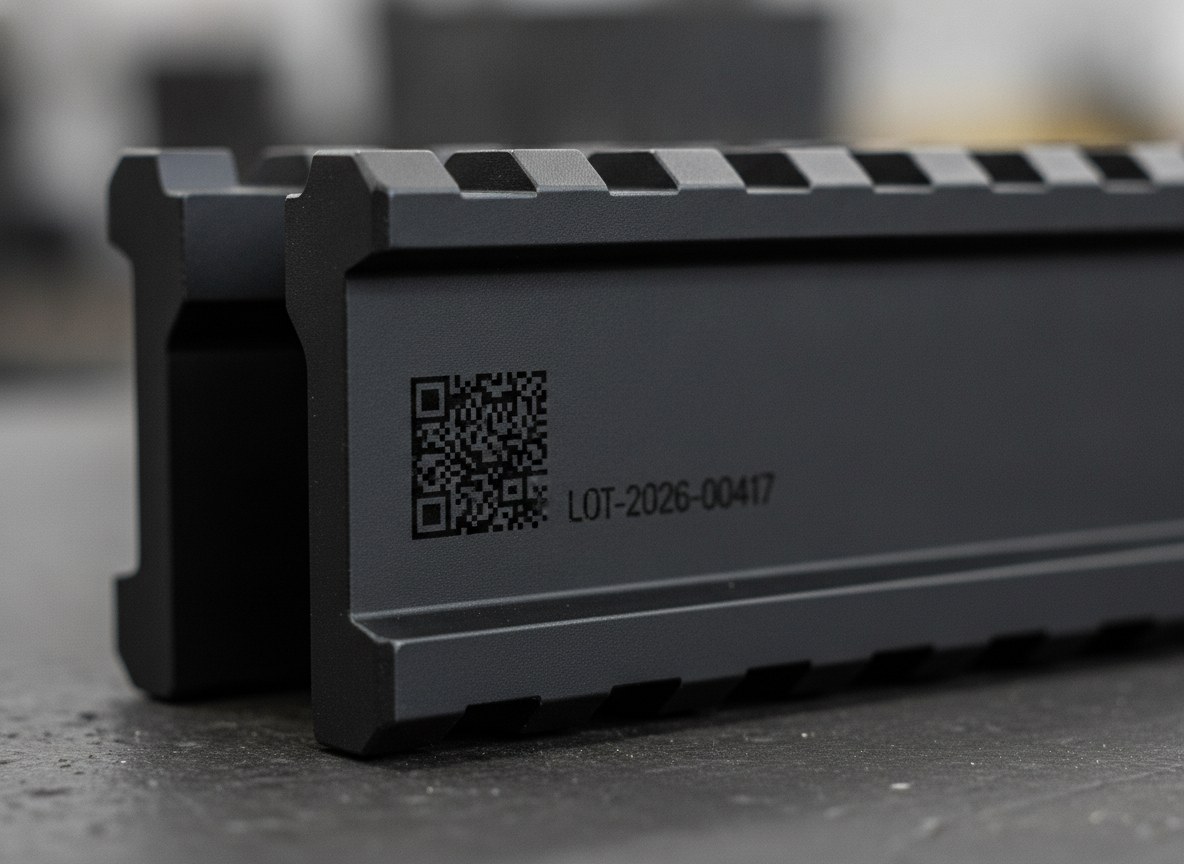
Picosecond-pulse fibre laser marking addresses both requirements together: it produces a matt, low-reflectance black while maintaining a constant contrast that remains stable over time.
Why reflectance is a process requirement, not an aesthetic detail
In defence the reflectance of a surface is not a matter of finish but of function. The treatments applied to components — matt black anodising on aluminium, bluing on steels, anti-reflective coatings on optical assemblies — serve to reduce the visual signature and to prevent the part from producing reflections in the field. A marking that introduces even a small specular area compromises the very property for which that treatment was chosen.
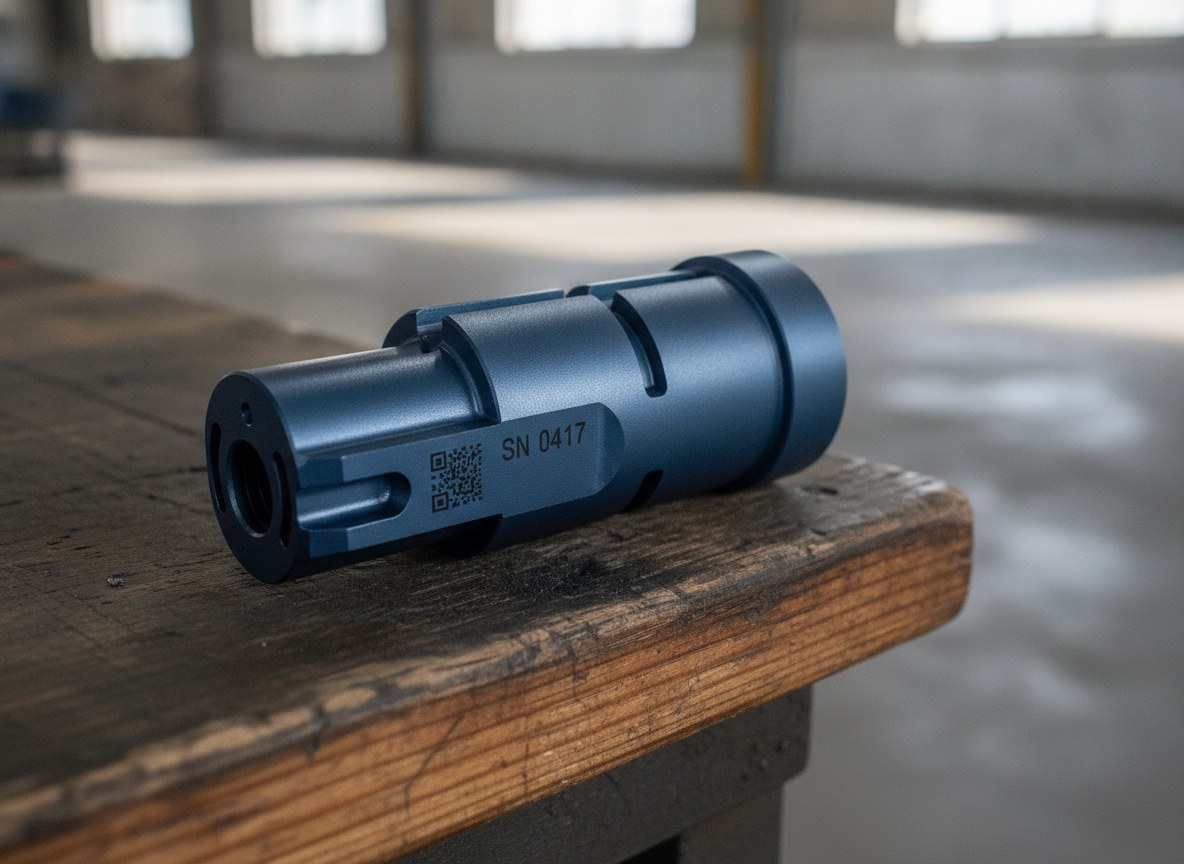
There is then the opposite issue: the same marking must remain legible, both to the human eye and to the optical reading systems that verify serial numbers and DataMatrix codes along the supply chain. High and stable contrast is therefore needed, but achieved without generating reflective surfaces. It is a balance that conventional marking processes handle with difficulty, because they tend to trade off contrast against reflectance: the deeper they mark, or the more they rely on oxidation, the more they risk leaving areas that reflect the light back.
Picosecond black: contrast without remelting
The difference with the picosecond lies in the pulse duration. A pulse lasting just a few picoseconds delivers its energy to the material in a time so short that the heat has no way to spread significantly into the surrounding area: material removal occurs by ablation, not by melting. The thermal impact on the substrate remains negligible — not zero, but contained enough not to alter the surface treatments around the mark.
The black obtained is neither an added layer nor a coloured oxidation: it is the result of a micro-structuring of the surface that traps the light rather than reflecting it. This explains why the mark appears as a matt black, deep and non-iridescent — the contrast remains identical from any viewing angle and under any illumination, an essential condition for the reliable reading of a DataMatrix. It is the same principle underlying the reflection-free marking that characterises this source.
Pulse duration Heat-affected zone shorter pulses, less heatReflectance control on anodised aluminium, blued steels and optics
On matt black anodised aluminium the risk of conventional marking is clear: by removing the anodising layer you expose the bright aluminium beneath, obtaining a light, reflective mark — the opposite of what is needed. The picosecond works on the outermost layer and produces a dark mark, consistent with the part’s matt finish, without opening reflective windows onto the base metal.
On blued steels the bluing is a thin conversion layer: a strong thermal input tends to burn it or discolour it around the mark. With the ultrashort pulse the marking remains contained and the surrounding bluing is not lifted. On optical components and their housings, where heat tolerance is minimal and any internal reflection degrades performance, the cold, low-reflectance marking makes it possible to identify the part without introducing sources of scattered light.
Resistance to solvents, abrasion and thermal excursion
One aspect that sets defence apart from general industry is the severity of the conditions the marking must survive. Components undergo degreasing with aggressive solvents, contact with oils and lubricants, repeated cleaning cycles, abrasion from handling and transport, and wide thermal excursions between Arctic and desert deployment.
Because picosecond marking is integrated into the structure of the surface and is not a deposit or a coating, it has no layer that can flake off or dissolve on contact with solvents. Not being a forced oxidation, it does not exhibit the fragility typical of marks obtained through strong thermal input, which tend to fade after thermal cycles or treatments. The matter of process consistency remains: real resistance must always be verified on the component’s actual materials and treatments, with tests on representative samples before validating the cycle.
Permanence and legibility of codes over time
Legibility and permanence are not the same thing. A code can be permanent yet still become illegible to an optical reader if the contrast or the geometry of the modules degrades. In defence the identification marking — often a DataMatrix associated with unique identification requirements such as those of MIL-STD-130 — must maintain a reading quality sufficient for the entire life cycle of the component.
This is where code quality control matters. Grading to standards such as AIM-DPM classifies the quality of the marked DataMatrix in line, assessing contrast, module damage and uniformity; formal verification, by contrast, requires controlled laboratory conditions and is a distinct operation from in-production grading. A matt black with constant contrast helps both, because it offers the reader a stable signal independent of the illumination angle. As a guide, the difference between reading, grading and verification clarifies the three levels of control.
What changes compared with standard industrial marking
Compared with standard industrial marking, the difference is neither the speed nor the depth of the mark, but the way in which contrast and surface are obtained. A conventional fibre marking favours contrast and productivity and, on most industrial components, remains the correct choice. When, however, the requirement includes low reflectance, preservation of the surface treatments and resistance under severe conditions, the logic changes: a process is needed that does not “attack” the surface in order to make itself visible.
| Aspect | Standard fibre marking | Picosecond marking |
|---|---|---|
| Contrast | High, but may shift with the viewing angle | Matt black, constant from every angle |
| Surface reflectance | Often residual due to micro-melting or exposed metal | Reduced, non-specular surface |
| Thermal impact on the substrate | Present (oxidation, remelting) | Negligible |
| Resistance to solvents and abrasion | Variable according to the type of mark | High, mark integrated into the surface |
This is why the picosecond finds its natural place in defence and in components where the mark must coexist with functional finishes: anodised aluminium, blued steels, optical assemblies, treated fasteners. It is a process choice, as already happens with marking in the defence sector and for the production of precision components.
It is not, however, the solution to adopt everywhere. On a foundry casting, on a component destined for painting or on an internal plate where reflectance is not an issue, a standard fibre source is more than adequate and often more sensible. The balance between mark depth and cycle time likewise depends on the relative weight of the requirements: the pulse duration has a direct bearing on the result, as described in the article on laser power and pulse duration. One criterion remains: the right marking is the one that satisfies the component’s most stringent requirement without compromising the others.

Applications Manager | LASIT
Applications Manager at LASIT for over 20 years, Mario Palmieri oversees the management and development of the company’s laser laboratory. He is responsible for conducting sample tests for customers, supporting the automotive, medical, aerospace and electronics sectors in identifying the most suitable laser marking solution for their needs.


